4.7 ★ on GoogleCarolina Custom Concrete
Lake Norman, NC · Insured concrete contractor
Polished Concrete & Concrete Floor Grinding
Mechanically ground and polished concrete floors for garages, basements, workshops and showrooms across Lake Norman and north Charlotte — the finish is the slab itself, refined, rather than a coating laid over it. Free written estimates.
InsuredFree written estimates
SureCrete systemsWallStamp · WallSpray
(704) 966-9268Call or text
What are we building?
Pick the closest match — we will get the specifics when we walk the job.
We respond in less than 2 hours
01 · What polishing is
The floor is the slab. Not something on it.
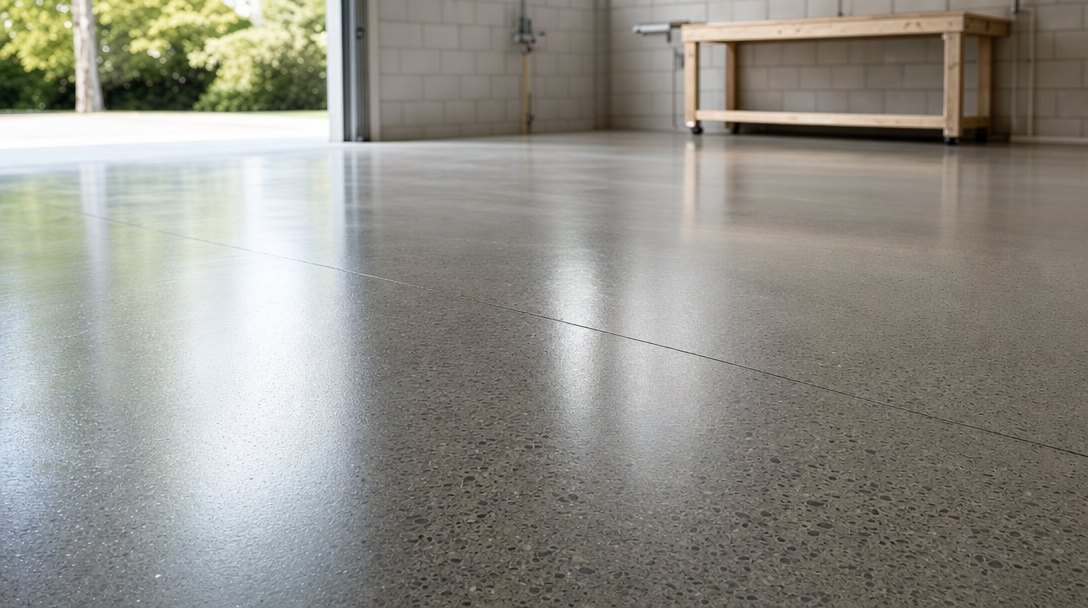
Polishing is mechanical. Diamond tooling on a floor grinder makes a series of passes, each one finer than the last, cutting the surface flat and then refining it until it takes a sheen. Nothing is added to make the shine — the light is bouncing off concrete that has been progressively closed up, which is why a polished floor cannot peel, flake or delaminate the way a coating can.
Partway through that sequence the floor is treated with a densifier, a liquid hardener that reacts with the concrete and makes the surface denser and more abrasion-resistant. That step is what separates a genuinely polished floor from one that has simply been ground and sealed, and it is the reason the finish keeps working underneath foot traffic and tyres.
How far up the grit sequence you go decides the look: stop early and the floor is matte and honed; carry on and it becomes satin, then reflective. That is a choice on the estimate, not a fixed outcome.
0
Layers to peel
The finish is the concrete itself
3
Exposure levels
Cream, fine aggregate or full stone
4.7
Stars on Google
Across 52 reviews
02 · Exposure and sheen
Two decisions make the floor.
Every polished floor is described by how deep the first cut goes and how far the polishing sequence is carried. They are independent choices.
| Exposure | What the first cut removes | How it reads |
|---|---|---|
| Cream / no exposure | Almost nothing — only the very top skin | Closest to a plain slab; the existing character is kept |
| Fine / salt-and-pepper | The cream layer, reaching the sand | An even speckle across the floor; the most forgiving of the three |
| Full aggregate | Deeper, into the stone in the mix | A terrazzo-like floor of exposed stone; the most dramatic and least forgiving |
Sheen is the second axis, and it runs from matte through honed and satin to fully reflective. A higher sheen shows more of the room in the floor and also more of the floor's own history, so on an older slab a lower sheen is often the better-looking answer as well as the cheaper one. Color can be introduced with dyes before the final passes — that overlaps with stained concrete, and dyes are the family that suits polished floors best.
03 · Polished, coated or stained
Three different answers to one question.
People arrive asking for a nicer floor. Polishing is one of three routes, and the slab usually decides which.
Polishing refines the concrete you already have. It suits a sound, reasonably flat slab and it gives a finish with nothing on top to fail. Floor coatings — epoxy, flake and metallic systems — add a new layer over the slab, which is the right call when you want a color or a pattern the concrete cannot give you, or when the surface is too damaged to be worth refining. Staining changes the color of the slab without changing its surface, and is often combined with either of the other two.
The slab is what settles it. A floor with heavy patching, previous coatings soaked into it, or wide movement cracks is a poor candidate for polishing, because grinding exposes all of that rather than hiding it — the same honesty problem the stained-concrete page sets out. If the slab has moved rather than merely aged, that is a repair conversation before it is a finish conversation.
04 · Where it suits
Garages, basements, workshops and showrooms.
Polishing is an interior finish here, and the reason is the weather rather than the floor.
Garages and workshops are the most common request: a polished floor sweeps clean, does not trap dust the way bare concrete does, and has no coating to lift when a hot tyre sits on it. Basements take polishing well and it is worth checking moisture coming up through the slab first, as it is for any floor finish. Showrooms and commercial interiors use it for the same reasons at a larger scale — that scope sits with the commercial package.
Outdoors it is a different question. A high-sheen surface is not the right finish for a patio, a pool surround or anything that gets wet and walked on, and freeze-thaw works on an exterior slab in ways an interior floor never sees. For outside, the honest answers are a broom finish, stamped concrete or an overlay.
05 · Straight answers
Polished concrete questions, answered straight.
The ones that decide whether your slab is a candidate.
What is the difference between polished concrete and an epoxy floor?
Polished concrete is the slab itself, ground and refined with diamond tooling until it takes a sheen — there is no added layer, so there is nothing to peel or delaminate. An epoxy or metallic coating is a new surface applied over the concrete, which is what you want when you need a color or pattern the slab cannot give you, or when the existing surface is too damaged to refine. The floor coatings page covers that route.
Can any concrete floor be polished?
No, and it is worth finding out early. Grinding exposes the slab's history rather than hiding it: heavy patching, old coatings that soaked in, and wide movement cracks all show in the finished floor. A sound, reasonably flat slab is a good candidate; one that has moved needs a repair conversation first. We look at the floor before anything is quoted.
Is polished concrete slippery?
A polished floor is no more slippery than any other hard floor when it is dry, and a higher sheen does not by itself mean less grip. Wet is the case that matters, which is why sheen level is chosen for the room — and why polishing is an interior finish rather than something we would put on a pool surround or an exterior walkway.
What is a densifier and why does it matter?
It is a liquid hardener applied partway through the polishing sequence that reacts with the concrete and makes the surface denser and more abrasion-resistant. It is the step that separates a genuinely polished floor from a slab that has been ground and then sealed, and it is why the finish keeps working under traffic instead of dulling quickly.
How much aggregate will show?
That is your choice and it is set by how deep the first cut goes: barely any (a cream finish that keeps the slab's existing character), an even salt-and-pepper speckle, or full exposed stone that reads like terrazzo. Deeper exposure is more dramatic and less forgiving of an uneven slab, so it suits a newer floor better.
Can a polished floor be colored?
Yes — dyes are worked in before the final passes and are the coloring family best suited to polished floors, because they carry deep into a densified surface. That overlaps with our stained concrete work, and the two are often specified together.
06 · Related guides
Keep reading.
07 · Free estimate
Send us a photo of the floor.
A wide shot of the room and a close-up of any patching, cracks or old coating is enough to tell you whether the slab is a polishing candidate.
(704) 966-9268- Free written estimate
- Fully insured
- Call or text, seven days
Huntersville · Cornelius · Mooresville · Denver · Concord · North Charlotte · Troutman · Statesville