
4.7 ★ on GoogleCarolina Custom Concrete
Lake Norman, NC · Insured concrete contractor
Concrete Curbing & Landscape Edging
Continuous concrete curbing for beds, borders and driveway edges across Cornelius, Huntersville, Mooresville and the rest of Lake Norman — poured in one unbroken run rather than laid as separate blocks. Free written estimates.
InsuredFree written estimates
SureCrete systemsWallStamp · WallSpray
(704) 966-9268Call or text
What are we building?
Pick the closest match — we will get the specifics when we walk the job.
We respond in less than 2 hours
01 · What curbing is
One continuous run. Not a line of blocks.
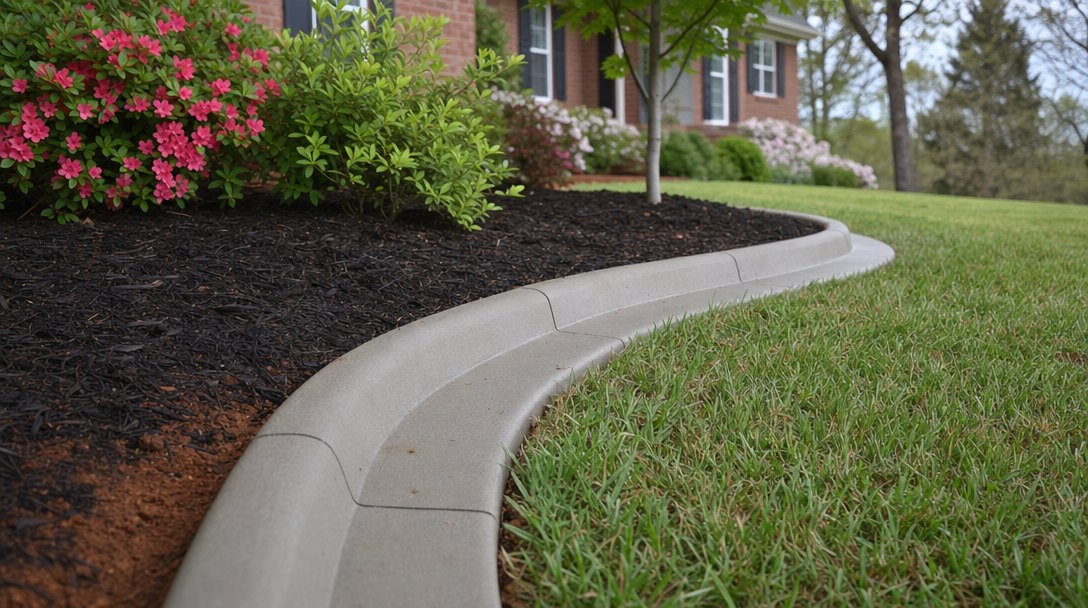
Landscape curbing is extruded on site: the mix is fed through a machine that shapes and lays the curb in a single continuous ribbon, following whatever line the bed takes. Because it is one piece rather than a row of separate units, there are no joints for weeds and mulch to work through, and nothing to lift, wander or fall over the way individual blocks and plastic edging do.
Control joints are cut into it afterwards at regular spacing. Those are deliberate — they give the curb somewhere to crack as the ground moves underneath it, which is the same reason a driveway gets jointed. A curb without them still moves; it just picks its own crack line.
The practical effect is a hard edge between two things that otherwise migrate into each other: mulch out of the bed, grass into it. That is most of why people buy it, and it is worth being plain that it is an edge, not a retaining wall.
1
Continuous pour
No joints between units to weed
8
Towns served
Huntersville through Statesville
4.7
Stars on Google
Across 52 reviews
02 · Where curbing goes
Beds, borders, drive edges and tree rings.
The same detail does four or five different jobs around a property, and the profile changes with the job.
Planting beds are the common one: a curb around the bed holds the mulch in and keeps the mower off the plants, and the mower wheel can ride the curb instead of the bed. Driveway and walkway edges take a curb where the slab meets lawn and the edge has started to crumble or the grass has crept over it — see driveways and walkways if the slab itself is the problem. Tree rings and island beds get the same treatment on a tighter radius.
What curbing is not is a structural wall. Anything holding back a grade change of any real height is a retaining wall question, and on a commercial site the curb, apron and stormwater details are part of the commercial package rather than a landscape detail. If you are not sure which one your job is, describe the height difference on the phone and we will tell you.
03 · Profiles and finishes
The shape is a choice, and so is the surface.
Curbing is specified by profile — the cross-section the machine extrudes — and then optionally colored or textured like any other decorative concrete.
| Profile | Shape | Suits |
|---|---|---|
| Mower / slant | Low, with the face angled back | Bed edges where a mower wheel needs to ride up on it |
| Rolled top | Rounded crown, gentle on both sides | The general-purpose bed and border edge |
| Square / straight | Flat top and vertical face | Formal beds and anywhere a crisp architectural line is wanted |
| Deeper border | Taller face, more of the curb below grade | Holding a slightly higher bed, or where mulch depth is greater |
Color goes through the mix rather than onto the surface, the same way it does in stamped work, and a roller stamp can press a brick, slate or running-bond texture into the curb while it is still green. Both are decided before the pour, not after, because both are part of the material rather than a coating on top of it. A sealer is what protects the color afterwards — the interval here is shorter than national guidance suggests, for the reason the cleaning and sealing page sets out.
04 · Our ground
Curbing on Piedmont clay.
The soil that makes driveways here move does the same thing to a curb, at a smaller scale.
Cecil clay swells when it takes water and shrinks when it dries, and anything sitting on it rides that movement. For a slab that is a base-preparation problem; for a curb it is mostly a question of what the curb is bedded on and whether it has been jointed often enough to crack where somebody chose rather than where the clay chose. A curb laid on loose spoil or straight onto un-compacted fill will telegraph every wet season.
The other local variable is irrigation. A bed edge that sits in the throw of a head stays damp, and damp clay moves more than dry clay. It is worth saying where the heads are when we walk the line, because it changes where the joints want to be. The same reasoning is set out at length for slabs in the clay-soil finishes guide.
05 · Straight answers
Curbing questions, answered straight.
The ones that decide whether curbing is the right detail for your yard.
How is concrete curbing different from paver or plastic edging?
Curbing is extruded on site as one continuous ribbon, so there are no joints between units. Pavers and plastic edging are separate pieces laid in a line, which is why they eventually lift, separate or wander as the ground moves and why weeds and mulch find the gaps. A continuous curb moves as one thing, and the control joints cut into it decide where it cracks.
Will concrete curbing crack?
Concrete cracks; the job is to control where. Curbing is cut with control joints at regular spacing so the movement in the ground below shows up at a cut line rather than in a random break. What causes the ugly kind of cracking is a curb bedded on loose or un-compacted ground, which is a preparation question rather than a material one.
Can curbing be colored or stamped?
Yes. Color is mixed through the batch rather than painted on, and a roller stamp can press a brick, slate or running-bond texture into the curb while it is still green. Both are decided before the pour. Colored and textured curb is sealed afterwards, and that sealer has a resealing interval like any other decorative concrete here.
Can I mow over it?
That is what the mower or slant profile is for — the face is angled back so a wheel can ride up onto the curb and the blade clears the edge, which is the main reason people choose that profile over a square one. On a square-profile curb you will still be trimming the edge by hand.
Is curbing a retaining wall?
No. Curbing is an edge — it separates a bed from a lawn and holds mulch in. Anything holding back a real change in grade is a structural question and belongs with masonry or, on a commercial site, with the concrete package. Tell us the height difference and we will say which one you are looking at.
Do you install curbing around an existing driveway?
Often, yes — a curb along a drive edge is a common job where the grass has crept over the slab or the edge has begun to break down. If the slab edge itself is failing rather than just untidy, that is a repair or replacement conversation first, because a new curb against a crumbling edge does not fix the edge.
06 · Related guides
Keep reading.
07 · Free estimate
Send us the bed line.
A photo along the line you want edged, and a rough length in feet, is enough for a first number on curbing.
(704) 966-9268- Free written estimate
- Fully insured
- Call or text, seven days
Huntersville · Cornelius · Mooresville · Denver · Concord · North Charlotte · Troutman · Statesville