What an epoxy garage floor costs
Two numbers are worth carrying into any conversation with a coatings contractor, and one of them explains almost every quote you will be given.
Published 2026 figures from Angi and HomeGuide put installed epoxy flooring at $4 to $10 per square foot, which works out at $1,600 to $5,800 for a typical two-car garage. Broken apart, the same sources put the resin itself at $1 to $5 per square foot and labor at $3 to $5. Other published calculators run higher — Homewyse puts the basic job at $7.78 to $12.71 per square foot — which is a fair signal of how much site conditions move the number.
Those are national figures rather than our quotes, and they carry the usual caveat: nobody publishes a price for your slab. What they are useful for is recognising a quote that sits far outside them, in either direction, and asking why.
| System | What it is | Where it sits on price |
|---|---|---|
| Solid color epoxy | One color, no decorative broadcast | The bottom of the range |
| Flake / chip | Vinyl flake broadcast into the coat, then clear-coated | The middle, and the most common residential choice |
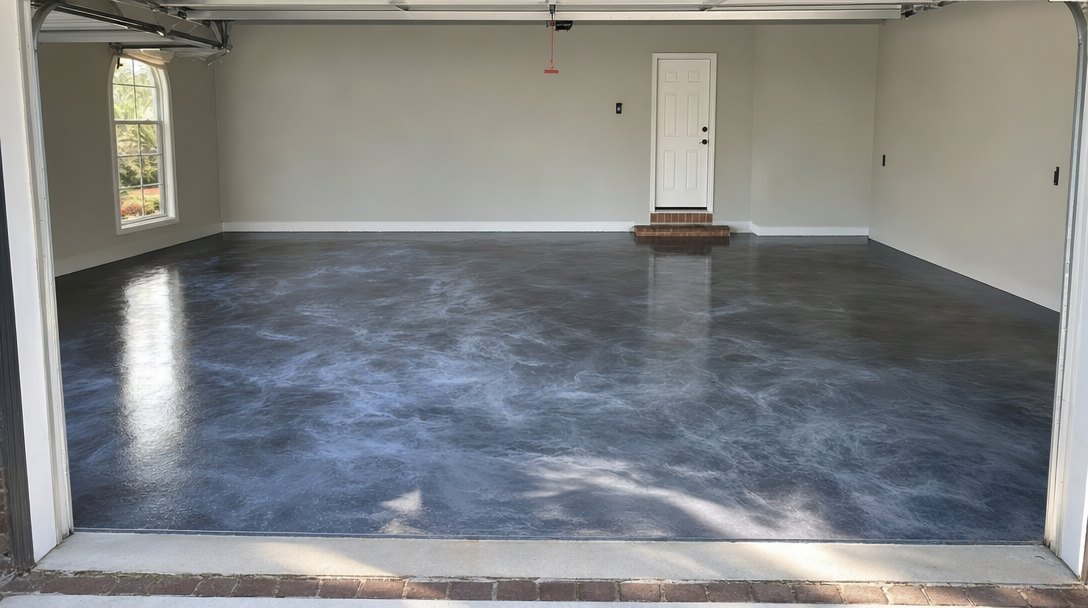
| Metallic | Pigments moved through a clear resin for a poured, marbled look | The top of the range |
| Polyaspartic top coat | A faster-curing, more UV-stable clear over the system | Adds cost; often sold as a one-day floor |
What you are actually buying
Almost every garage floor coating is a stack of layers rather than a single product, and quotes differ in how many layers they include.
A full system is usually a primer, one or two build coats, whatever decorative element you have chosen, and a clear top coat. A cheaper quote often has fewer layers in it — a single-coat product with no primer and no separate clear coat is a real thing that is sold as an epoxy floor, and it is not the same purchase. Ask how many coats, and ask what the top coat is.
The other genuine difference is the resin. Epoxy is hard and chemical-resistant but it ambers in sunlight, which matters for a garage whose door stands open. Polyaspartic and polyurea cure much faster and hold color better under UV, which is what makes the one-day installations possible and part of why they cost more. Our floor coatings page covers which systems we work with.
Why preparation is most of the price
The single largest variable in a coatings quote is not the coating. It is what has to happen to the concrete first.
A coating is only as good as its bond, and concrete straight off the trowel is too closed to bond to. The surface has to be opened up — mechanically, by diamond grinding or shot blasting — so the resin has something to key into. That is labor and machine time, and it is the line that moves most between a quote for a clean new slab and a quote for a twenty-year-old garage.
Then there is what the grinding finds. Oil that has soaked in has to be drawn out or cut away, because resin will not bond through it. Cracks and spalled patches are filled and made flat. An old failing coating has to come off entirely, which can cost more than the new floor. And moisture moving up through the slab from the ground below will lift a coating off no matter how well the surface was prepared, so it is tested for first — that one matters here, because a slab on Piedmont clay with poor drainage around it is a realistic candidate.
None of that is optional and none of it is visible in the finished floor, which is exactly why it is the corner most often cut.
Reading a quote that looks too cheap
A number well under the published range is not automatically wrong. It just always means something, and it is usually one of four things.
| What is different | What to ask |
|---|---|
| Acid etching instead of grinding | How is the slab being prepared? Grinding or shot blasting, or chemical etch? |
| Fewer coats than a full system | How many coats, and is there a separate clear top coat? |
| A thinner or water-based product | What is the solids content, and what is the top coat? |
| No moisture test | Has the slab been tested for moisture coming up through it? |
Etching with acid instead of grinding is the most common of the four and the hardest to see afterwards. It costs less because it is quicker, and on a slab that needed mechanical profiling it is the reason a floor peels in sheets two winters later. The coating on top can be identical.
When the honest answer is not a coating at all
Coating is one of three ways to end up with a better garage floor, and it is not always the right one.
If what you want is a floor that is easy to sweep, does not raise dust, and has nothing on it that can peel, then polishing the slab is worth pricing alongside a coating. There is no added layer, so there is no bond to fail and no hot-tyre pickup — the trade is that you get the concrete's own color and character rather than a color you chose.
A coating wins when you want a specific color or a decorative finish the slab cannot give you, or when the surface is too damaged to be worth refining. And if the slab has cracked because it has moved, rather than merely aged, neither is the first job — that is a repair conversation, because both a coating and a polish will simply follow the crack.
Epoxy garage floor questions.
The ones that decide what you should be paying.