Repair, resurface or replace: the decision rules
Almost every call about damaged concrete resolves to the same question, and you can usually answer it yourself before anyone comes out.
Has the ground under it moved, or is the problem on the surface? If the concrete is structurally sound and the damage is at the surface — staining, dullness, flaking, light spalling, a finish you have stopped liking — you are in repair or resurfacing territory. If the slab has settled, rocks underfoot, or has cracks that reopen wider each year after being filled, the sub-grade has moved and the concrete is following it.
| What you see | What it means | Route |
|---|---|---|
| Hairline cracks under about ½″, slab flat | Normal shrinkage and movement, structurally fine | Repair |
| Surface flaking or spalling in patches, slab flat | Freeze-thaw or salt damage at the surface only | Repair or resurface |
| Dull, stained, worn finish; no movement | Purely cosmetic — the slab is doing its job | Resurface |
| Cracks that reopen wider after filling | Something is still pulling them open | Replace |
| Sections at different heights, or slab rocks underfoot | Settlement and voids beneath the slab | Replace |
| Alligator / map cracking across an area | Widespread structural failure, not a surface issue | Replace |
What concrete repair fixes: local damage on a sound slab
Repair is the right answer more often than the industry admits, and it is the cheapest of the three.
Repair addresses specific, local damage: filling and sealing cracks that are stable, patching a spalled area, re-establishing an edge, dealing with a single failed section. The test is whether the rest of the slab is sound and sitting where it should be.
What repair does not do is change how the driveway looks overall. A patched area on a weathered slab will be visible, because new concrete and fifteen-year-old concrete do not match and largely cannot be made to. If appearance is the actual problem, repair is the wrong tool and resurfacing is the right one.
See concrete repair for what this involves.
What resurfacing fixes: everything above the concrete
An overlay is a new surface bonded onto the slab you already have.
Resurfacing changes the entire appearance of a driveway without removing it. Because the existing slab stays, the three most expensive parts of a replacement — removal, haul-away and re-grading the sub-grade — come off the job entirely. The new surface can be finished plain to read as new concrete, or stamped, textured and colored.
The constraint is absolute and worth repeating: an overlay inherits whatever the slab underneath is doing. It adds no structural capacity, does not stop settlement, and cannot bridge a crack that something is still pulling open. Applied over a moving slab it fails in a way that looks exactly like the original problem returning, because it is the original problem returning.
When driveway replacement wins the math
Replacement is the most expensive route and sometimes the only one that is not a waste of money.
It wins in three situations. When the sub-grade has moved, because that is the one problem only opening the ground up can address. When damage is across most of the slab rather than concentrated, at which point repairing everything costs more than starting again and still leaves you with an old driveway. And when the repair would cost a significant share of the replacement without addressing why it failed.
That last one is the honest test, and it is the one worth applying skeptically to any quote — including ours. Money spent on a surface fix over moving ground is money spent twice, because the second conversation is the replacement you were trying to avoid.
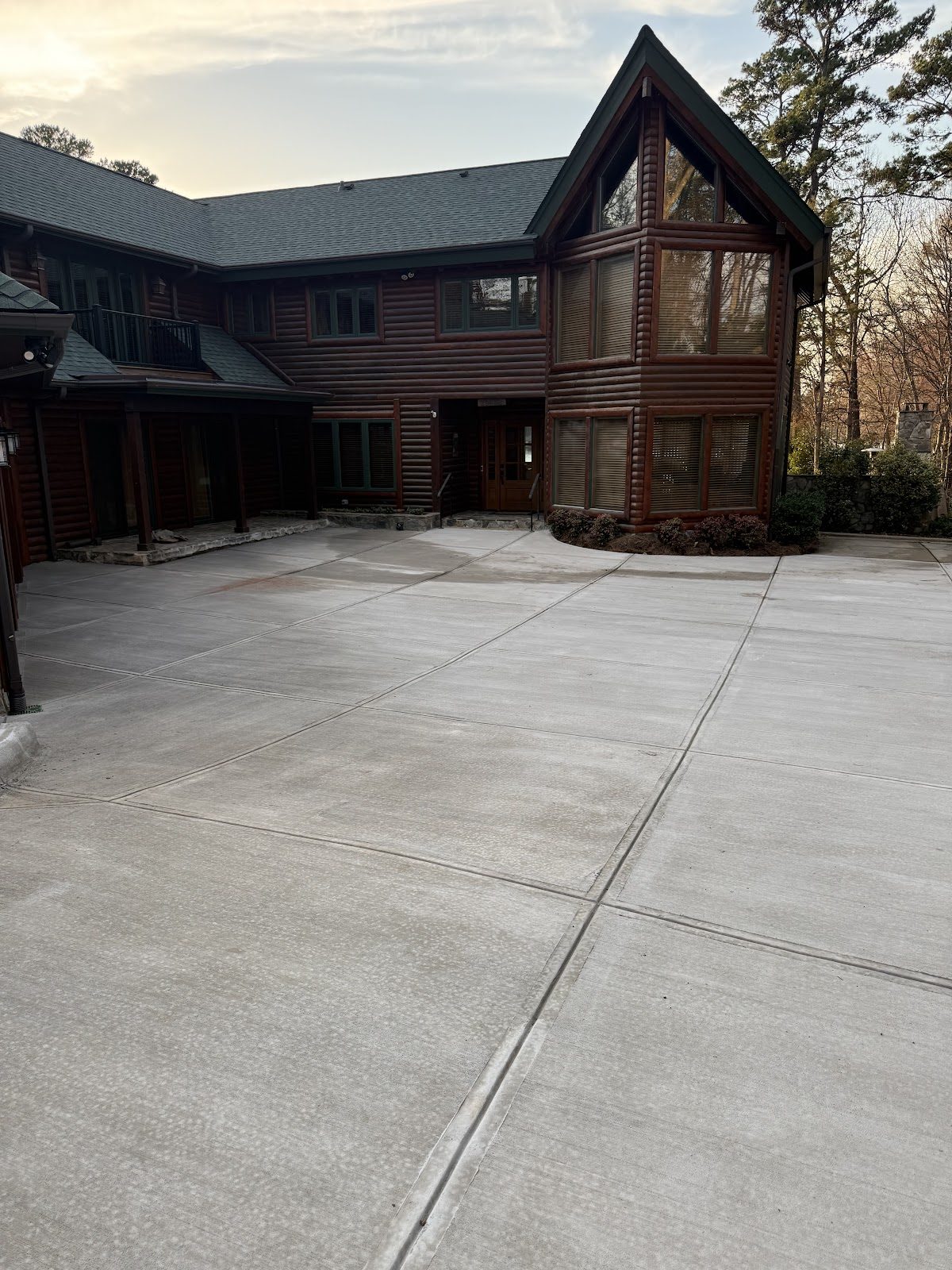
The value of a replacement is under it rather than on it: the ground gets opened up, re-graded and properly based, which is the part that decides how long the new concrete lasts. See driveway replacement.
Why driveways fail around Lake Norman: red clay and freeze-thaw
Local ground is most of the reason this decision comes up as often as it does around Lake Norman.
Cecil soil — the red clay this region sits on, and North Carolina's state soil — shrinks as it dries and swells as it takes water. That is seasonal, it is unavoidable, and it is transmitted into whatever is sitting on top of it. A slab on a properly compacted base spreads its load and handles that movement for a long time. A slab poured onto whatever was left after the last one came out does not.
On top of that, the Piedmont gets repeated shallow freeze–thaw cycling rather than one long freeze. Water gets into the surface, freezes, expands, thaws and repeats. That cycle works on the top few millimetres, which is why surface spalling is common here and why sealing is worth more locally than the national guidance suggests.
Two different mechanisms, two different symptoms, two different answers — and telling them apart is the whole of this page. Clay moves the slab; freeze-thaw damages its surface. The first is a replacement conversation. The second usually is not.
Repair or replace questions.
The ones that decide which route you are on.