
Repair, resurface or replace a pool deck
Three different jobs, three very different numbers, and one question that decides between them.
The question is whether the concrete has moved or merely aged. A deck that is structurally sound and simply looks finished — surface crazing, wear, dated colour, a slippery or too-hot finish — is a resurfacing job. A deck whose slabs have settled, heaved or cracked right through is a replacement job, and putting an overlay on it buys you a nicer-looking version of the same problem within a couple of seasons.
Published 2026 figures make the stakes plain: resurfacing runs $3 to $15 per square foot depending on the system, while full replacement runs $30 to $55 per square foot including disposal of the old deck. Resurfacing typically saves 40% to 60% and most jobs finish in two to four days rather than leaving the pool area off-limits for a fortnight. That is a strong bias toward resurfacing — which is exactly why the diagnosis has to be honest.
Which one do you have
You can get most of the way to the answer yourself, on foot, before anyone quotes anything.
| What you can see | What it usually means | Likely route |
|---|---|---|
| Surface crazing, wear, dated colour | The surface has aged; the slab has not moved | Resurface |
| Hairline cracks with both sides level | Normal shrinkage the joints absorbed | Resurface |
| One section sits lower than its neighbour | The ground under it has settled | Lift and level, then resurface — or replace |
| A crack with a lip you can catch a shoe on | The slab has moved differentially | Repair or replace that section |
| Cracks radiating from the pool shell | Possible movement at the bond beam | Assess before anything else |
| Hollow sound when tapped | The slab has lost contact with its base | Assess |
The lip test is the most useful one. Run a shoe across each crack: if both sides are level, the slab has cracked but not moved, and that is a surface problem. If one side sits proud of the other, the ground beneath has shifted, and no overlay bonded to that slab will stay flat. Our repair, resurface or replace guide applies the same test to driveways.
What each route costs
The published spread within resurfacing is almost as wide as the gap to replacement, and it is driven by which system goes down.
| Route | Per sq ft | What you get |
|---|---|---|
| Basic concrete overlay | $3 – $7 | A new bonded surface; plain finish |
| Cool-deck coating | $4 – $8 | A finish specified to run cooler underfoot |
| Stamped or textured overlay | $8 – $15 | Pattern and colour in the new surface |
| Full replacement | $30 – $55 | Tear-out, disposal, re-grade and a new slab |
A mid-size deck typically lands between $2,400 and $7,200 to resurface on those published figures, against $5,400 to $16,200 or more to replace a 900-square-foot deck, plus $2 to $6 per square foot for removing the old slab. Those are national figures rather than our quotes — what they are good for is knowing roughly which order of magnitude a conversation should be in.
The coping, the bond beam and the expansion joint
A pool deck is not just a patio that happens to be near water. Three details make it its own job.
The coping is the cap around the pool edge, and the joint between coping and deck is an expansion joint rather than a crack to be filled solid. It is meant to move. When that joint is caulked hard or overlaid across, the deck and the pool structure end up tied together, and the next seasonal movement has to go somewhere — usually into a crack radiating away from the shell.
The bond beam is the top of the pool structure itself. Cracks that appear to start at the pool edge and run outward deserve a look before any surface money is spent, because a deck problem and a pool-structure problem look similar from above and are not the same repair at all. That is not a resurfacing decision; it is a stop sign.
And the fall matters. A deck should shed water away from the pool, and a deck that ponds is one that will keep telling you about it. An overlay can adjust surface drainage a little; it cannot re-grade a deck that was poured to the wrong fall.
Lakefront decks around Lake Norman
The local variable is not the pool. It is what the ground around it is doing.
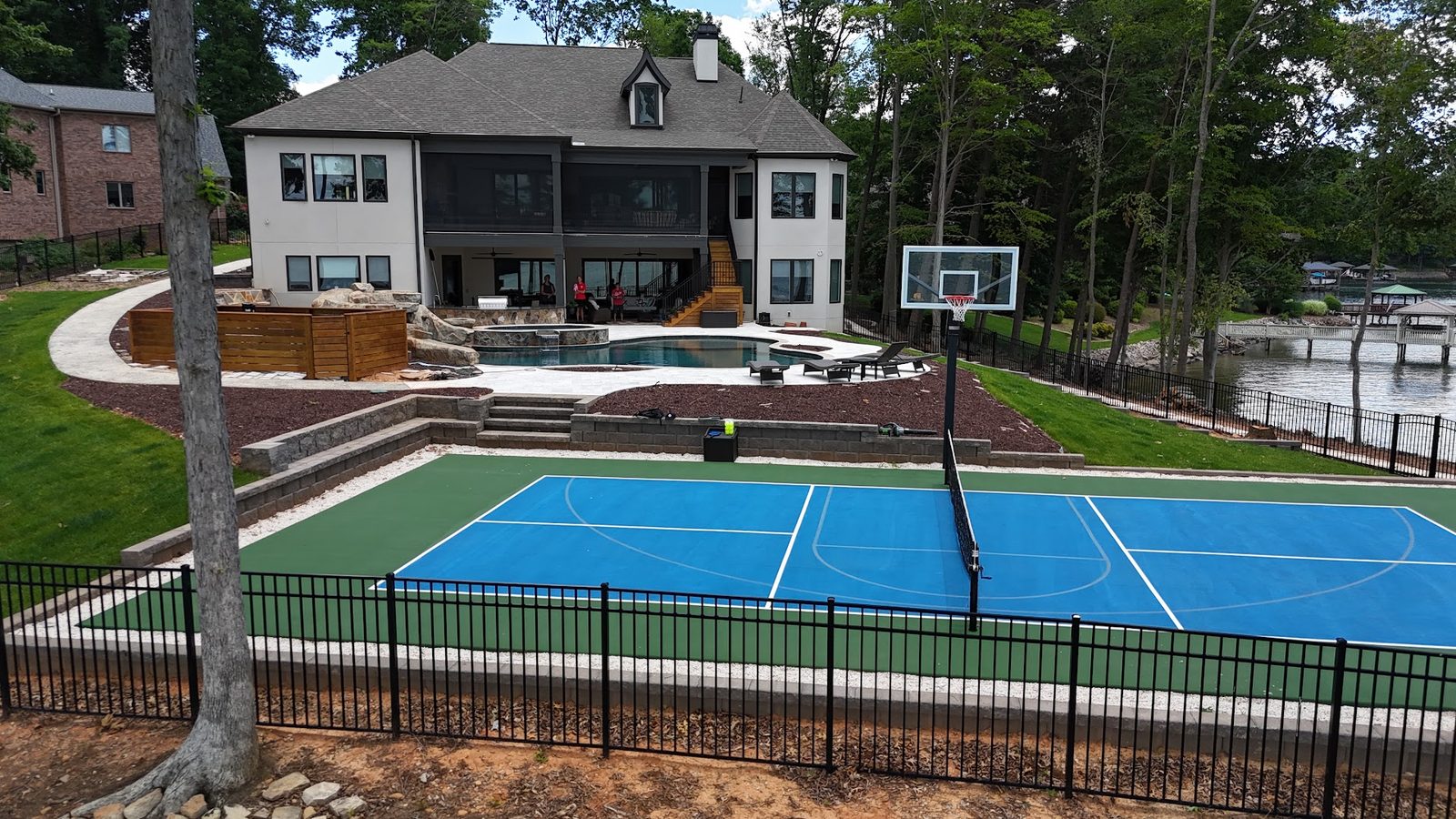
A lot of the pool decks here sit on lots that fall toward the water, on the same Cecil clay that moves seasonally everywhere else in the Piedmont. Cut-and-fill lots are the ones to watch: a deck poured partly on undisturbed ground and partly on fill has two different foundations under one slab, and that is where the differential settlement that rules out resurfacing tends to show up.
Slope also concentrates water. A deck at the bottom of a graded lawn takes everything the lawn sheds, and saturated clay under one edge of a slab moves more than dry clay under the other. Our lakefront lots guide covers what those sites demand from a pour, and the Cornelius resurfacing guide works through a local example.
Pool deck questions.
The ones that decide which of the three jobs you are buying.