
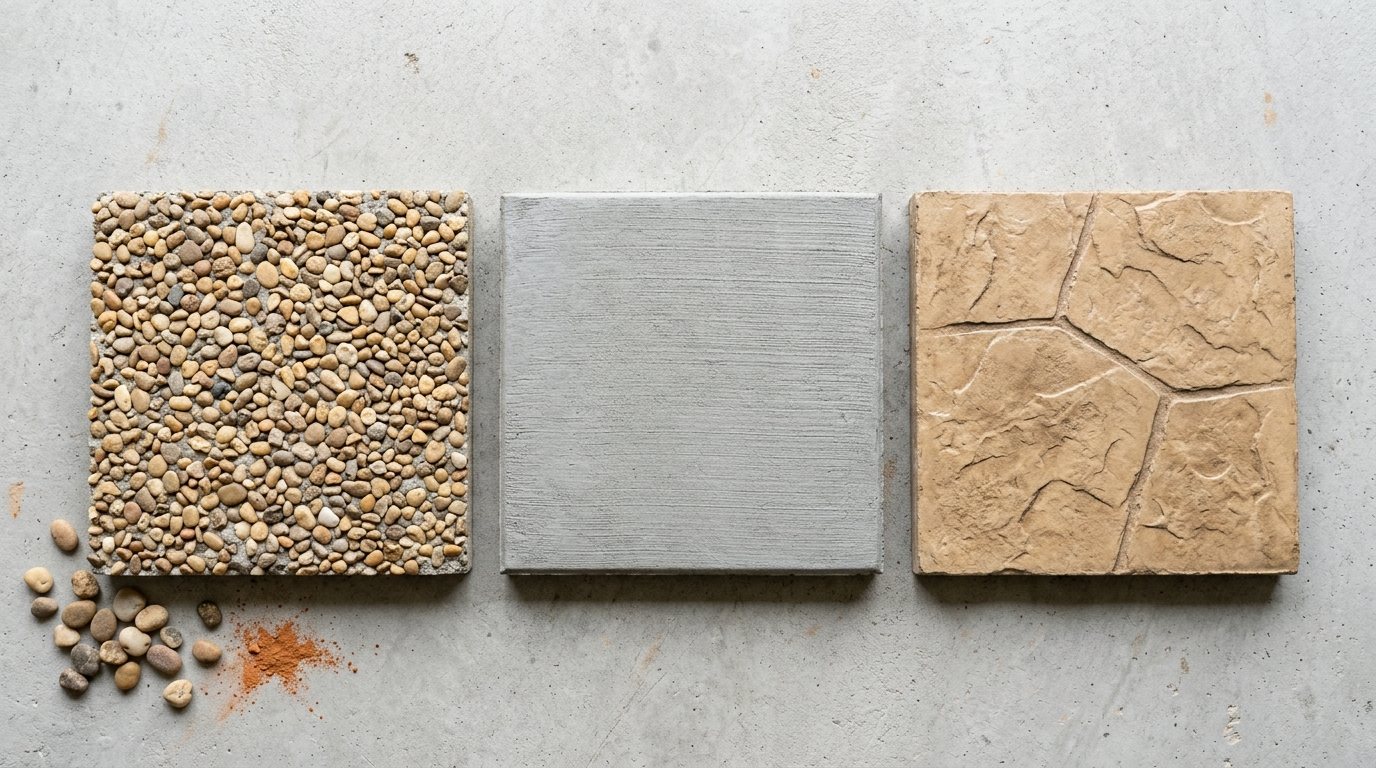
Exposed aggregate concrete is a slab whose top film of cement paste is brushed and washed away before it hardens, so the stone inside the mix becomes the walking surface. Around Lake Norman it earns its place in two spots: wet pool decks and driveways that fall toward the water, because the industry rates exposed stone slip resistant. It costs more than a broom finish and less than stamped, and we price it on site once we have seen the slab, the access and the stone you want.
It also does something quieter that matters on Piedmont clay. Red runoff shows plainly on gray concrete. On a field of tan, brown and gray river gravel it is far harder to see.
Key takeaways
- What it is: the paste on top of a fresh slab is washed off at the right hour, leaving stone at the surface. Timing is the whole craft.
- Where it pays off here: pool decks and sloped lakefront driveways, where the Portland Cement Association (PCA) rates the finish slip resistant.
- Price position: above broom, below stamped concrete. A finisher covers about one third of the area he would steel-trowel, per the PCA. Our cost guide puts exposed aggregate above broom for that extra finishing labor.
- Heat changes the schedule: with Charlotte Douglas averaging a 90.3 °F July high, summer flatwork here gets a morning slot.
- Sealing: first coat after cure and dry-out, then on a schedule set by product, sun and traffic rather than a fixed calendar.
Three ways to put stone on top
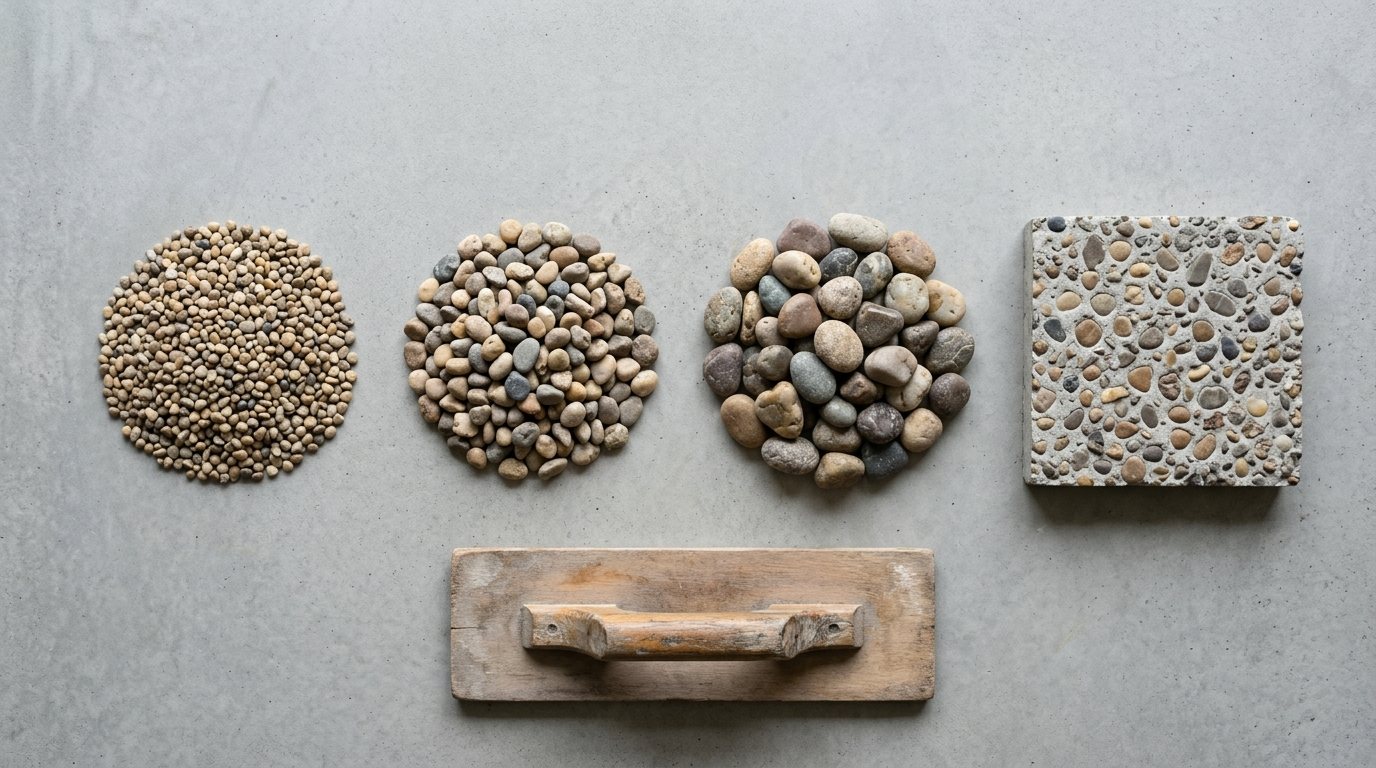
"Exposed aggregate" covers three different builds, and they are not interchangeable. The PCA's guide to decorative slabs, written by Steven Kosmatka and Terry Collins, separates them clearly.
Seeded. A normal slab is placed and struck off slightly low, then a select stone is spread across the wet surface in a single layer and tapped in with a float until mortar surrounds and slightly covers the stone. This is the version people usually picture, because the seeded stone is chosen for color and size, independent of the stone in the ready-mix. The PCA puts seeding stone at roughly 3 pounds per square foot for 3/8 inch stone and up to 6 pounds per square foot for 2 inch stone.
Monolithic. The decorative stone is mixed through the whole batch, usually a gap-graded mix, and the surface is exposed the same way.
Topping course. A special topping layer carrying the gap-graded decorative stone goes over a base slab, and that layer is what gets exposed.
In each case the exposure step is identical: light brushing first, then brushing with a fine water spray, repeated in passes until the rinse water runs clear and there is no cement film left on the stone. Rush it and you pluck stones out. Wait too long and the paste has set around them.
Why the wash-off is a morning job on Lake Norman
Everything about exposed aggregate hangs on one window: the hour when the slab is firm enough to hold a finisher on kneeboards without marking, yet the surface paste still brushes away. The PCA's test is exactly that, plus one more: if brushing dislodges stone, stop and wait.
Heat shrinks that window. NOAA's 1991 to 2020 climate normals put the average July high at Charlotte Douglas at 90.3 °F, and a slab poured on a July afternoon sets faster than the crew can keep up with across a whole driveway. The PCA's answer is a surface retarder, sprayed on after floating, which slows the set of the top layer only; it says one may be necessary on large jobs or during hot weather. Even then it warns that during high temperatures any patch the retarder missed can set and refuse to expose, so the surface has to be checked regularly and exposed within a few hours.
That is why summer flatwork here gets booked for a morning slot with the truck ordered early, as our guide to the Lake Norman pour window explains. Exposed aggregate simply has less room for error than a broom finish: the broom texture is drawn once, while an exposed surface is worked in passes over several hours, and paste that has been washed off cannot be put back.
One state road agency spells the timing out in hours. A New York State DOT specification for exposed aggregate surfacing has the retarder sprayed within one hour of placement, the slab kept under 6 mil black plastic for 12 to 16 hours, and only then the paste washed off with a high pressure hose. Residential work on a lake lot is smaller and faster, but the steps are similar.
Exposed aggregate vs broom vs stamped
This table puts numbers where numbers exist and says so where they do not. Prices are the national figures already published in our Charlotte driveway cost guide, not a quote.
| Factor | Exposed aggregate | Broom | Stamped |
|---|---|---|---|
| How the texture is made | Surface paste washed back to show stone | Broom pulled across the fresh surface | Pattern mats pressed into the fresh surface |
| Stone size | Chosen stone, from 1/4 in. up to 2 in. in PCA gradations | Ready-mix stone, hidden under paste | Ready-mix stone, hidden under paste |
| Depth of texture | No more than 1/3 of average stone diameter (PCA); 3/16 in. in one NYSDOT spec | Shallow broom lines | Set by the pattern chosen |
| Finishing labor | About 1/3 the area per finisher of a steel-troweled slab (PCA) | Less than exposed (our cost guide); the PCA figure is measured against steel-troweled work | Adds material and labor over broom |
| Grip when wet | Rated slip resistant (PCA) | Grips when wet | Depends on the texture chosen |
| Red-clay staining | Hidden well by varied stone color | Shows it more than the other two | Pattern and color disguise it |
| Published price, per sq ft | Between the two; quoted on site | $9 to $16 (plain concrete) | $14 to $24 |
| First sealing | Two acrylic coats after 3 days wet cure and 30 days air dry (NYSDOT) | Worth sealing here, not required | Sealing protects the color; a separate service (our stamped page) |
Read the price row carefully. We have not published a per-square-foot figure for exposed aggregate and we are not going to guess one here, because the stone you pick moves it. Two decorative stones can differ widely in cost, and the PCA itself warns that crushed stone adds labor because it stacks during seeding.
Grip on pool decks and sloped lake lots
"Exposed-aggregate finishes are rugged, slip resistant, and highly immune to wear and weather."Steven H. Kosmatka and Terry C. Collins, Finishing Concrete Slabs with Color and Texture, Portland Cement Association, 2004
The same passage names pool decks, patios, driveways and sidewalks as ideal uses. That lines up with how we think about pool decks: slip resistance is a function of texture, not of material, and exposed stone is about as much texture as a slab can carry.
There is a catch the PCA flags directly. Crushed stone can leave sharp edges on the finished surface, which it calls undesirable on pool decks. Around a pool, the stone should be rounded river gravel, and the smaller the stone and the shallower the exposure, the kinder the deck is to bare feet.
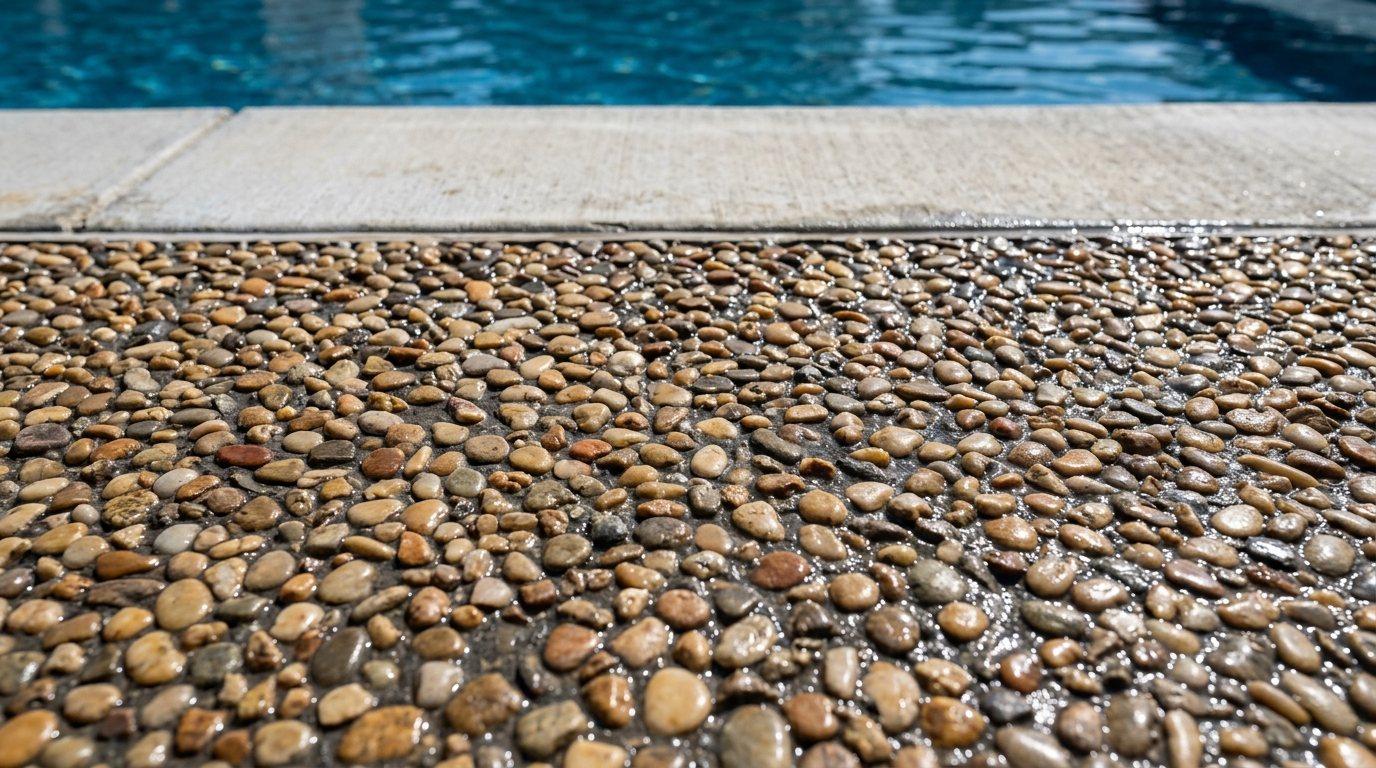
Driveways on lakefront lots bring a different problem: slope. A steep drive in Cornelius or on a Mooresville peninsula carries runoff across its whole length every time it rains, and a wet slope is where grip gets tested. Exposed stone helps. It does not replace drainage. The PCA usually sets edge forms for a minimum fall of 1/4 inch per foot so water leaves the slab, and a slab that holds water will stain and wear no matter what finish sits on it.
Red clay, iron and choosing the stone
Piedmont clay is red because it is rich in iron oxide, and that iron is what leaves rust-colored streaks where runoff crosses a slab. The finish choice matters here in a way it does not in sandier places, which is the argument we make at length in our guide to finishes on Huntersville clay. A varied stone surface hides that staining far better than smooth gray paste.
There is a mirror-image risk in the stone itself. The PCA says the aggregate to be exposed must not contain iron oxides or iron pyrite, because those can stain the surface from within, and it recommends petrographic testing to confirm a stone is inert and free of iron oxide. In plain terms: ask where the stone comes from and whether it has a staining history. A decorative gravel that rusts will do to your patio what the clay was already trying to do.
Freeze-thaw is the other local factor. Winters here bring shallow, repeated freeze-thaw cycles rather than deep frost, and they work on the surface layer. For concrete exposed to freezing, thawing and deicing salts, the PCA calls for air-entrained concrete with 5 to 8 percent total air and a maximum water-cement ratio of 0.45. That is a mix decision made before the truck leaves the plant, and it is worth asking about by name.
Sealing schedule in Piedmont heat
Sealing an exposed aggregate surface does two jobs. It brings the color of the stone up, the way a pebble looks better wet, and it slows the paste between the stones from absorbing clay and dirt. The PCA points toward sealers based on methyl methacrylate, silane or siloxane, and warns that some coatings, linseed oil among them, can darken the surface or yellow in sunlight.
The first coat waits. The New York spec quoted above wet-cures for a minimum of 3 days, air-dries for 30, then applies two coats of acrylic sealer. The PCA likewise says any acid wash to brighten the stone should wait at least two weeks after placement, and longer is better. Those are agency and industry specs, not a homeowner rulebook, but they make the point: the first seal waits for the slab to cure and dry.
After that first coat, how often to reseal depends on the product on your slab, how much sun and traffic it takes, and what it sits next to. A pool deck taking chlorinated splash every day and full afternoon sun will need attention sooner than a shaded front walk. We handle that as its own service through concrete cleaning and sealing, and the cleaning is not a formality: a sealer applied over embedded dirt seals the dirt in.
When stamped is the better call
Exposed aggregate is not the answer to every decorative slab, and we would rather say so here than after the pour.
- You want a stone or wood look. Exposed aggregate looks like concrete with stone in it. If the goal is flagstone, slate or wood plank, that is what stamped and decorative concrete is for.
- The patio is mostly bare feet and furniture. A textured stone surface is less comfortable underfoot and harder to sweep. On an outdoor room where people sit more than they walk, a stamped or broom finish on a concrete patio is often the more livable choice.
- You are matching existing work. Matching a stamp and color to a patio poured two years ago is possible. Matching a washed stone surface to an old one depends on finding the same stone and hitting the same exposure depth, which is harder.
Combinations work well too. The PCA's own guide shows a patio of plain broom-textured panels framed against exposed aggregate panels, one way to keep stone where you want grip and a smoother surface elsewhere.
What to settle before we pour
Each exposed aggregate job is a little bespoke, so these are the questions we work through at the estimate, and the ones worth asking any contractor:
- Which stone, and where from? Size, shape (rounded for bare feet), color, and whether it is free of iron staining.
- Seeded, monolithic or topping? Each changes the look and the cost.
- Retarder or timed wash? Ask whether a retarder is planned; summer pours here get a morning slot.
- Exposure depth. Shallow enough to keep the stone locked in; a sample panel settles it. Both specs call for a sample panel: the PCA builds it before the work, and in the NYSDOT spec the approved sample becomes part of the finished slab.
- Mix for freeze-thaw. Air entrainment and water-cement ratio, by number.
- Sealing plan. Product, first-coat timing and who does the resealing.
If you are weighing exposed aggregate for a pool deck, driveway or patio in Huntersville, Cornelius, Davidson, Mooresville or Denver, call us at (704) 966-9268 or request an estimate.
Frequently asked questions
The questions that come up once exposed aggregate is on the table.
What is exposed aggregate concrete?
Is exposed aggregate slippery around a pool?
Does exposed aggregate cost more than stamped concrete?
How often does exposed aggregate need sealing?
Can exposed aggregate go on a sloped driveway?
Is exposed aggregate comfortable barefoot?
How deep should the stone be exposed?
Sources
- Kosmatka, S. H. and Collins, T. C., Finishing Concrete Slabs with Color and Texture (PA124), Portland Cement Association, 2004.
- New York State DOT, Item 608.011100ER, Exposed Aggregate Concrete Surfacing.
- NOAA National Centers for Environmental Information, U.S. Climate Normals, 1991 to 2020 (Charlotte Douglas).