How much does a new concrete driveway cost per square foot?
Published figures, named to their source and stated per square foot so you can scale them to your own drive.
The commonly published national range for a new concrete driveway is about $8 to $20 per square foot, and Angi puts the average driveway at roughly $6,400.
We are quoting those rather than inventing our own because we have not yet published local bands from completed jobs, and a made-up narrow figure would be worse than a wide honest one. What matters is knowing where in that range your lot sits — and that is decided by access, grade and finish long before it is decided by size.
The section below sets out the finish ladder in relative terms, which is the part of pricing that transfers between markets even when the absolute numbers do not.
The finish ladder: what each step up actually buys
Finish is the factor you control most directly, and the one where relative cost is more useful than absolute cost. These are published per-square-foot comparisons, not our prices.
Broom is the baseline. It is the standard driveway finish because the texture is produced by the finishing process itself rather than by adding anything — grip when wet, nothing to maintain.
Exposed aggregate sits above it. More labor at finishing, and a surface with more visual texture and more grip.
Colored and stained adds pigment through the slab or into the surface. Acid stain in particular gives mottled, translucent color that varies across the pour, so no two slabs read the same.
Stamped is the top of the ladder, at a published $14–$24 per square foot against plain concrete's $9–$16. The comparison that matters is not against plain concrete though — it is against what it imitates. Pavers are published at $16–$28 and travertine at $20–$34, so stamped is the cheaper route to a stone look, with no individual units to settle, shift or weed.
Every figure on this page is published by a third party and named to its source. None of them is a Carolina Custom Concrete price. We quote per site after walking it, and we would rather show you the method than a number that cannot know your driveway.
Concrete or asphalt: the trade-off in this climate
Worth a paragraph because it is the other question people are weighing at the same time.
Asphalt is generally cheaper to install and more expensive to own. The trade-off commonly cited for North Carolina is a service life of 25–30-plus years for concrete against 15–20 for asphalt, and the summer heat here is hard on asphalt in a way it is not on concrete — it softens and ruts under standing vehicle weight.
Concrete also takes finishes. Asphalt is black, and stays black.
What a driveway extension costs differently
Widening for a third car, adding a turnaround or a parking pad, squaring off a corner — extensions are priced on a different basis to either a new drive or a replacement, and usually a friendlier one.
An extension is a first-time pour on open ground. There is no old slab to break out and nothing to haul away, which removes the cost line that makes replacements expensive. On the published figures that is the $1–$6 per square foot removal premium simply not appearing on the bill.
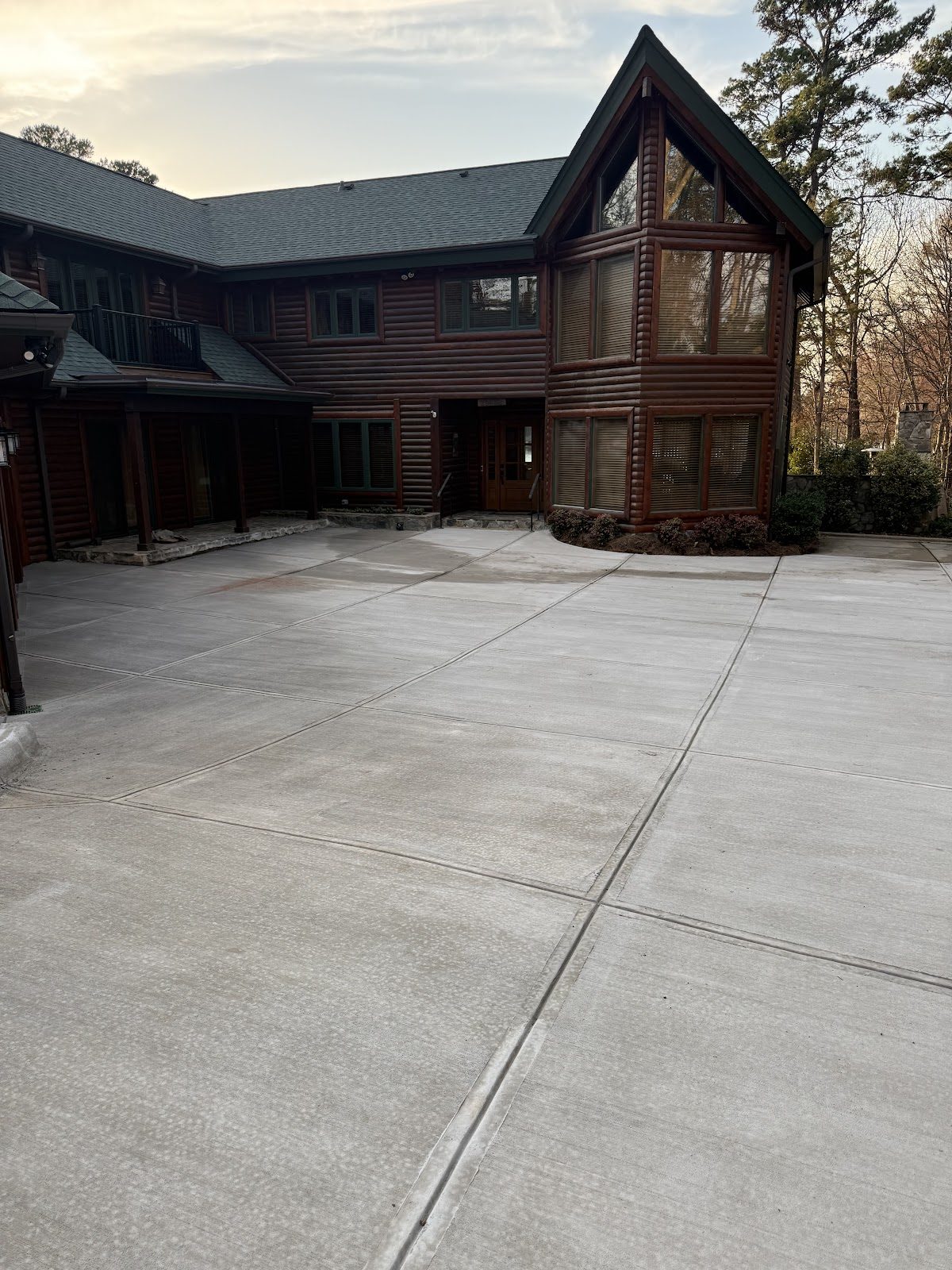
What it adds instead is the tie-in. New concrete placed against an existing slab has to be jointed so the two move independently rather than fighting each other, and that joint has to be placed deliberately rather than wherever the pour happens to end. It is a small piece of work that decides whether the join opens up in two winters.
The other thing to plan for is color. New concrete is lighter than old and stays lighter for a long time — it does not cure to a match. On a visible front drive that is worth seeing before you commit, and it is one reason some people extend and then clean-and-seal the whole surface together so the two halves read as one.
Where an extension reaches the road, widening the entrance onto a state-maintained road does alter the access — which is the case where an NCDOT driveway permit applies.
What moves the price of a new driveway
| Factor | What it does to the total |
|---|---|
| Access | Whether a ready-mix truck can reach the pour. Where a chute cannot reach, concrete moves by hand — hours of labor a chute does in minutes. |
| Sub-grade | What is under it once it is opened up. Angi names Piedmont red clay as a top cost driver and puts grading work at around $3,300 where drainage has to be corrected. |
| Square footage | The obvious one, and the least interesting. On a long or awkward drive it moves the number less than the three factors above. |
| Finish | Broom is the baseline. Published per-square-foot comparisons run concrete $9–$16 against stamped $14–$24. |
| Tie-ins | Aprons, street connections, steps and any transition to an existing slab. A new or widened entrance onto a state road also needs an NCDOT permit. |
When there is already a driveway: two different bills
If there is already a driveway where the new one is going, this is not the right guide.
A replacement carries a whole cost line a new pour does not: breaking out the old slab, hauling it away, and cutting the sub-grade back to where it should have been. Published figures put that removal premium at roughly $1–$6 per square foot on top of the pour, which is why two driveways of identical size can quote very differently.
Extensions sit in between — a first-time pour on open ground with no tear-out, plus the work of tying new concrete into an old slab so the two move independently.
New driveway cost, answered.
The questions people ask before they commit to a pour.