Which is cheaper, concrete or pavers
On installed cost, concrete usually wins. On the cost of living with the surface for twenty years, the gap narrows and can reverse.
Published 2026 figures from Angi put a paver driveway at $10 to $30 per square foot installed, averaging around $12,000, with most homeowners spending $6,000 to $18,000. A paver patio runs $8 to $25 per square foot, with an average job near $3,800 for 280 square feet. Against that, published comparisons put stamped concrete at $14 to $24 per square foot — and a plain broom-finish concrete slab sits below all of it.
So the honest summary is: plain concrete is clearly the cheapest surface to install, decorative concrete overlaps heavily with the middle of the paver range, and a high-end paver installation is the most expensive thing on the list. If someone tells you pavers are always dearer, they are comparing a cheap slab to an expensive paver job.
Driveways: where the gap is widest
A driveway is the job where the two materials diverge most, because a driveway has to carry weight.
| Surface | Per sq ft | Notes |
|---|---|---|
| Pavers | $10 – $30 | Average job around $12,000; most fall $6,000 – $18,000 |
| Stamped concrete | $14 – $24 | Published comparison figures |
| Broom-finish concrete | Below the stamped range | The standard drive finish here |
The number that decides a paver driveway is the base rather than the pavers. A driveway base has to be deeper and better compacted than a patio base, because it is taking vehicle loads on individual units rather than on one bonded slab, and that excavation and stone is a large share of the quote. It is also the part that is invisible when it is finished and the part that fails when it was skimped.
Concrete distributes those same loads across a continuous slab with steel in it, which is why a properly based four-inch drive handles a car without thinking about it. What it does instead is crack — and the job of the control joints is to decide where. Our driveway cost guide covers what moves that number locally.
Patios: where the choice is mostly aesthetic
On a patio the loads are trivial, so the decision comes down to look, repairability and what you want to be doing to it in ten years.
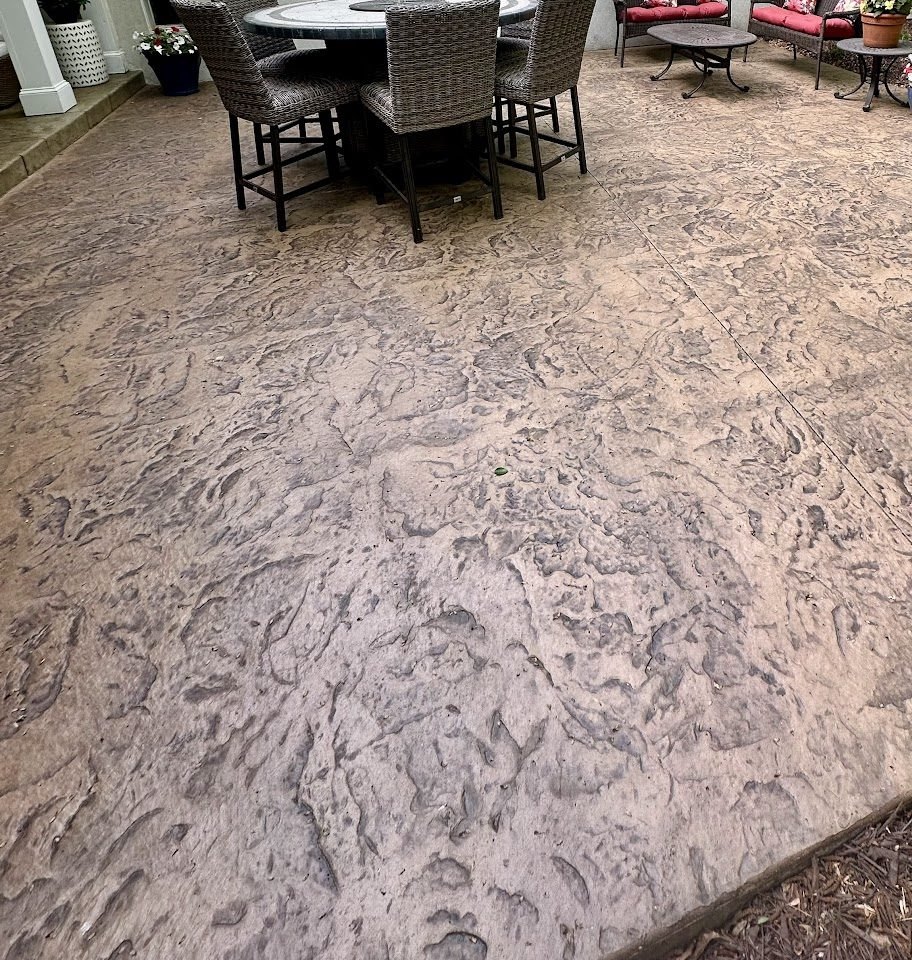
Published paver patio costs of $8 to $25 per square foot straddle the stamped concrete range almost exactly, which means for most patios the money is not the deciding factor — it is a genuine preference between a continuous surface with a pattern pressed into it and a modular one with real joints and real shadow lines. Flagstone and other high-end units push well past $25 and out of the comparison entirely.
What does move the money is complexity. Curves, borders, multiple unit sizes and cut-in features all add labor to a paver job in a way they do not to a pour, because every curve is cut units. Conversely a stamped pattern that needs several colors and a hand-detailed border adds to a concrete job. Compare like with like, or the published ranges will mislead you. The patio cost guide has the concrete side in detail, and stamped concrete vs pavers compares the two on everything except money.
The cost that arrives after the installer leaves
Both surfaces have a running cost. They are different in kind, which is why installed price alone is a poor way to choose.
| Concrete | Pavers | |
|---|---|---|
| Routine upkeep | Reseal decorative work on a schedule | Weeding, joint sand, occasional resetting |
| Failure mode | Cracks; joints decide where | Individual units settle; joints lose sand |
| Repair | Hard to patch invisibly — colour and texture rarely match | Lift the affected units, fix the base, relay the same units |
| After a utility dig | A visible patch, or a section replaced | The same units go back down |
This is the strongest argument for pavers and it deserves to be stated plainly by somebody who pours concrete: a paver surface is repairable in a way a slab is not. When a paver settles you lift it, fix what is underneath and put the same unit back, and the repair is invisible. When a slab cracks, the honest options are to live with it, to resurface the whole surface, or to replace the section — and a patched slab looks patched.
What Piedmont clay does to the comparison
The generic national comparison assumes generic ground. Ours is not generic, and it pushes the answer in both directions at once.
Cecil clay swells when it takes water and shrinks when it dries, so everything laid on it moves seasonally. For a slab, that movement is what control joints are for, and a well-prepared, well-drained base is what keeps the movement small enough for the joints to absorb. For pavers, the same movement shows up as individual units going out of level — which is more visible sooner, but is also the failure you can fix in an afternoon.
What the clay really rewards is base preparation, and that is true of both materials. A paver drive on a thin base and a concrete drive poured on un-compacted fill fail for the same underlying reason. That is the argument in our clay-soil finishes guide, and it applies whichever surface you buy.
Concrete against pavers, on cost.
The questions people actually ask before deciding.