Stamped concrete vs pavers: the sixty-second answer
Most of the content you will find comparing these two is published by companies that sell one of them. So is this. The difference is that this one concedes the other side.
| Stamped concrete | Pavers | |
|---|---|---|
| Installed cost | $14–$24/sq ft (published) | $16–$28/sq ft (published) |
| Failure mode | Cracks — joints decide where | Individual settlement and joint loss |
| Repairability | Hard to repair invisibly | Units can be lifted and reset |
| Maintenance | Reseal periodically | Weeding, joint sand, occasional resetting |
| Look | Continuous surface, pattern pressed in | Genuinely modular, real shadow lines |
| Best when | You want a continuous surface at lower cost | The ground moves, or access under it may be needed |
Stamped concrete vs pavers cost per square foot
It is the reason most people start this comparison, and it should not be the reason they finish it.
These are published national figures, not our prices. Every number on this page is attributed to the publisher it came from. We do not quote from a chart — concrete is priced per site, because the sub-grade, the access and the tie-ins are what move a number and none of them are visible in a national average. Use this page to understand what drives the cost, then have someone stand on the ground and give you a written figure.
Published per-square-foot comparisons run stamped concrete at $14 to $24 against pavers at $16 to $28, with travertine further up at $20 to $34. Angi's own stamped data puts the rate at $9 to $22 per square foot and HomeGuide at $8 to $19.
So stamped concrete is generally the cheaper installed surface, but the two bands overlap. A complex stamped job with borders and multiple colors can land above a simple paver field. Anyone telling you the gap is enormous is selling one of them.
Cracking and red clay: the real technical difference
This is where the honest version of this comparison lives.
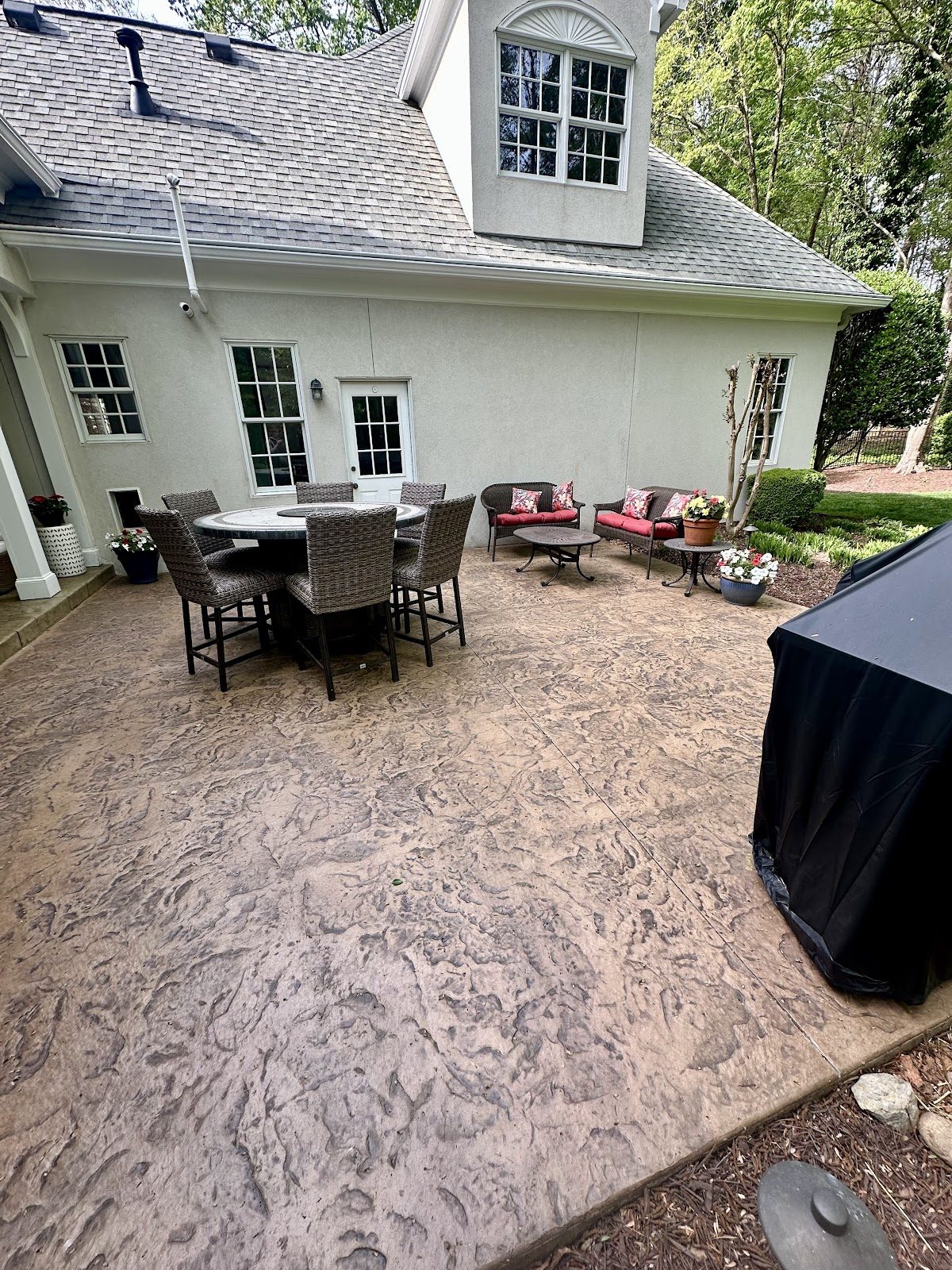
Concrete cracks. It is a rigid material that shrinks as it cures and moves with temperature, and the trade's answer is not to prevent cracking but to decide where it happens — that is what control joints are, cut into the slab on a grid. A slab with well-placed joints on a properly compacted base will crack along the lines somebody chose.
The Piedmont's red clay is the complicating factor. Cecil soil shrinks when it dries and swells when it takes water, and that seasonal movement is transmitted into whatever sits on it. This is why base preparation matters more here than the finish does, and why we say so on every page of this site.
Pavers have a genuine advantage on moving ground. A paver field is already in pieces, so movement shows as individual units sitting proud or low rather than as a crack across a surface — and those units can be lifted, the base corrected, and the same pavers put back down. You cannot do that with a slab. If your ground is known to move, that is a real point in the pavers column and we are not going to pretend otherwise.
Maintenance: one asks for your time, the other for your money
Neither is maintenance-free, and anyone who tells you theirs is has something to sell.
Pavers have joints, and joints are where the maintenance lives. They grow weeds, they lose their sand over time, and both want attention on a rhythm. None of it is difficult and most of it is a Saturday, but it recurs, and it recurs on your schedule rather than on somebody else's.
Stamped concrete has nothing to weed, because there are no joints to weed — only the control joints cut into it, which are sealed. What it wants instead is resealing, and published guidance commonly puts that at every two to three years at $200 to $600 per treatment. That is a job you pay somebody for rather than one you do, and it is easy to forget until the color has already gone flat.
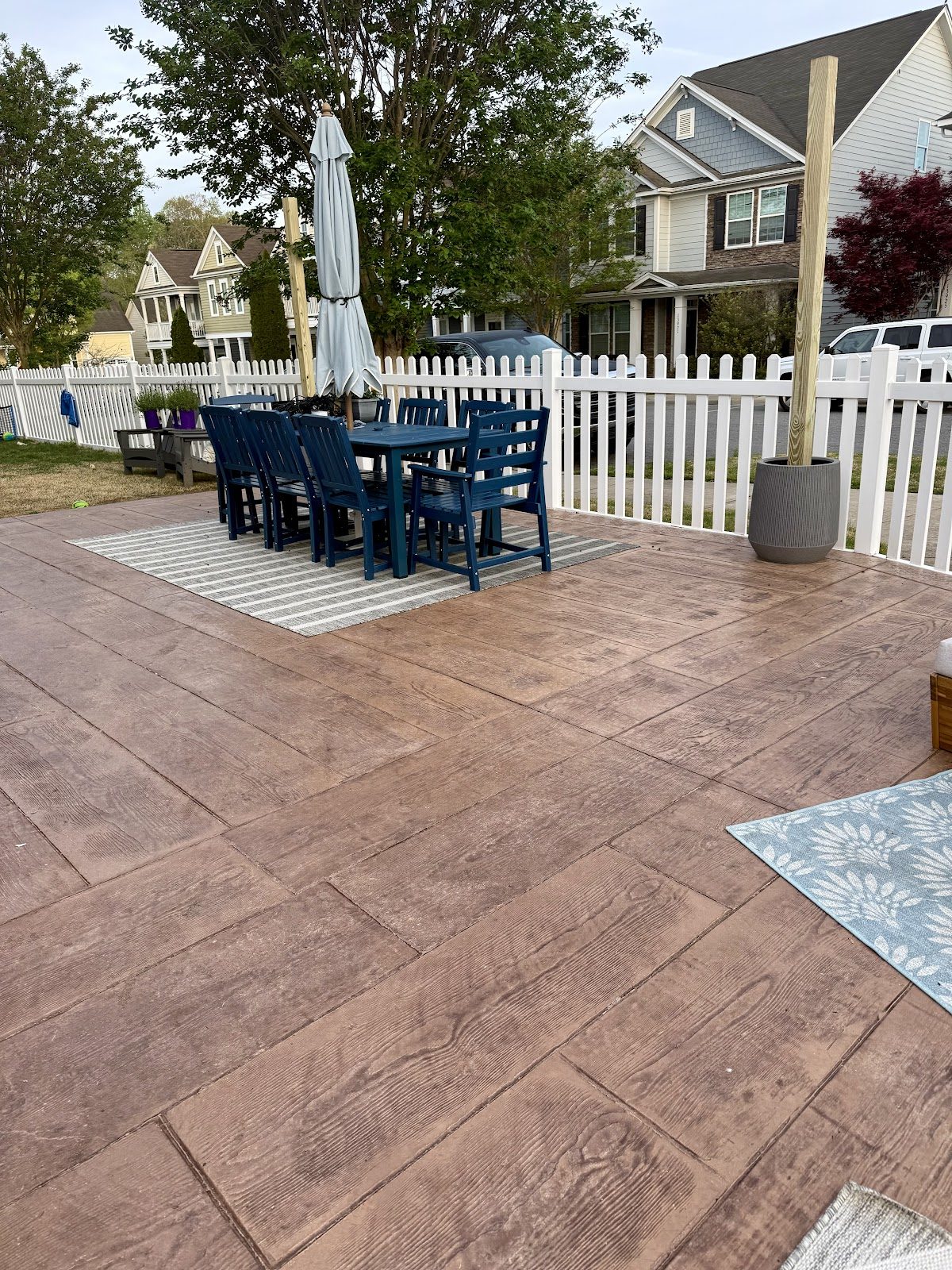
Locally there is a wrinkle worth knowing. Red clay is high in iron oxide and stains unsealed concrete, and the Piedmont's shallow freeze-thaw cycling works on exactly the surface layer a sealer protects. Sealing is doing more work here than the national guidance implies — our cleaning and sealing page goes into why.
Roughly: pavers ask for a little of your time often, stamped concrete asks for a little of your money occasionally.
Resale value: where both industries overclaim, including ours
This is the section where we are going to give you less than our competitors do, on purpose.
You will find confident percentages attached to both materials — a patio returns some specific share of its cost at sale, a paver installation adds some specific amount to a valuation. We are not going to give you one, because we would be making it up. Nobody selling either surface has the data to support a number that precise, and a figure you cannot check is worth nothing to you.
What is defensible is duller and more useful. A usable outdoor space helps a house sell, in either material. A space that looks like it belongs to the house helps more than one that looks bolted on. And a cheap installation of either material actively hurts, because a cracked slab or a settled paver field reads to a buyer as deferred maintenance they are about to inherit.
If resale is genuinely the driver, the useful question is not which material but whether the space will be used. An outdoor room somebody wants to sit in shows well. A rectangle of surface does not, whatever it is made of.
When we would tell you to pick pavers
We pour concrete. Here is when we would tell you not to buy it from us.
- When the ground is known to move. If a previous slab on the same spot has cracked and settled more than once, the honest answer may be a surface that can be taken up and reset rather than a better slab.
- When you may need access underneath. Services, irrigation and drainage under a proposed patio are a strong argument for a surface you can lift.
- When you actually want a paver look. Stamped concrete imitates stone convincingly and imitates pavers less convincingly, because what makes a paver field read as a paver field is the real joints and the real shadow between units. If that is the look you are after, buy it.
Where stamped concrete does win is a continuous surface at lower installed cost, a stone look without stone money, and nothing to weed. If that is what you want, the stamped concrete page covers how we build it, and the cost guide covers what the published numbers say.
The questions people actually ask.
Including the ones that do not favor us.