
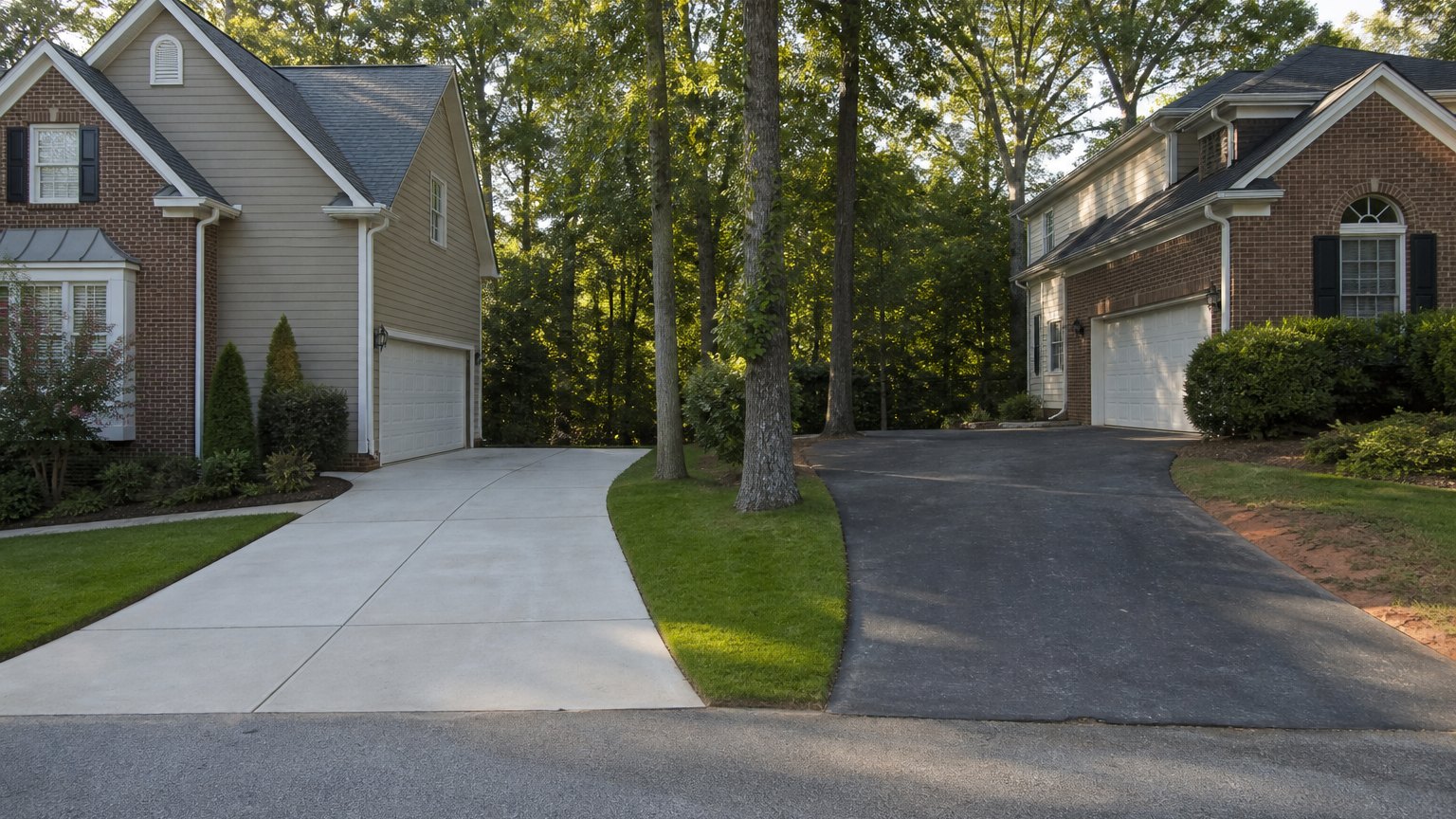
Concrete vs asphalt for a driveway comes down to three things published sources measure: how long the surface is expected to last, how hot it gets in summer, and how often it needs a coating. Carolina Custom Concrete pours concrete driveways in Huntersville, Cornelius, Davidson, Mooresville and Denver, NC, and this guide compares them on those three points.
We pour concrete. We do not lay asphalt, so read this knowing which side of the fence we stand on. That is also why every figure below carries the name of whoever published it, and why the last section is about the cases where asphalt is the better buy. If you already know you want concrete, our concrete driveway contractors page covers finishes, aprons and how the job runs.
Key Takeaways
- Asphalt has a published lifespan; a concrete driveway mostly does not. The National Association of Home Builders' 2007 life-expectancy study lists an asphalt driveway at 15 to 20 years and has no row at all for a concrete one.
- Both get hot. The U.S. EPA puts peak summer surface temperatures of conventional concrete and asphalt at 120 to 150 °F; the EPA notes new concrete has a high solar reflectance and is generally considered a cool pavement, though it darkens over time.
- Asphalt runs on a coating schedule. A 2016 U.S. Geological Survey fact sheet reports applicators recommend resealing asphalt every 1 to 5 years.
- Charlotte averages 58.3 days a year with a low at or below 32 °F (NOAA 1991-2020 normals), so either surface has to handle repeated shallow freezes, not one long winter.
- The ground decides more than the material. On red clay, a base that is compacted dry and graded to drain matters whichever surface goes on top.
The comparison in one table
Every row names its source. Where no institutional source publishes a figure, the cell says so rather than borrowing a number off a contractor's blog. None of this is a price; prices are on our concrete driveway cost guide for Charlotte.
| Factor | Concrete driveway | Asphalt driveway | Source |
|---|---|---|---|
| Expected service life (years) | No concrete-driveway row in the study | 15 to 20 years | NAHB, Study of Life Expectancy of Home Components (2007) |
| Peak summer surface temperature (°F) | Up to 120 to 150 °F for conventional pavements | Up to 120 to 150 °F for conventional pavements | U.S. EPA, Cool Pavements (2012) |
| Solar reflectance (% of sunlight reflected) | High when new; falls as traffic dirt darkens it | Low when new; rises as the binder oxidizes and stone shows | U.S. EPA, Cool Pavements (2012): conventional pavements range 5 to 40% |
| Routine coating interval (years) | Depends on the sealer; we set it per surface | Applicators recommend sealcoat every 1 to 5 years | Our sealing page; USGS Fact Sheet 2016-3017 |
| Sealer chemistry (PAHs, mg/kg) | Not applicable | About 50 in asphalt-based sealcoat; 50,000 to 100,000 in coal-tar-based | USGS Fact Sheet 2016-3017 |
| Finish options | Broom, exposed aggregate, color or stain, stamped | Black | Our driveway page |
| Typical fixes | Crack sealing, section replacement, resurfacing a sound slab | Patching and sealcoat (not work we do) | Our repair page; USGS on sealcoat use |
How long does a concrete driveway last compared to asphalt?
The only institutional table we could find gives asphalt 15 to 20 years and gives a concrete driveway no figure at all. That gap is worth understanding before anyone quotes you a lifespan.
The source is the National Association of Home Builders' Study of Life Expectancy of Home Components, published in February 2007 and built from a telephone survey of manufacturers, trade associations and researchers. Under Site and Landscaping it lists "Asphalt Driveway 15-20" years. It lists concrete as a flooring material at 50-plus years, and concrete footings and foundations as lasting a lifetime, but it does not list a concrete driveway. The study's own introduction says life depends on installation quality, maintenance, weather and how hard the thing is used.
So when you read a concrete-driveway lifespan online, check who published it. The figures we found while researching this guide came from contractors and home-improvement sites, not from a survey or a standards body. We would rather tell you what controls the life of a slab on this ground than hand you a number we cannot source.
What controls it, on our jobs, is the part nobody sees. A replacement on our driveway replacement page is four jobs in order: tear-out, cutting the sub-grade back to where it should have been, forms, then the pour. The second step is the one most often skipped, and a new slab poured on old fill tends to fail the way the last one did. That is true whether the old surface was concrete or asphalt.
Red clay and freeze-thaw: what each surface does
Charlotte's 1991-2020 climate normals from NOAA average 58.3 days a year with a low at or below 32 °F and 49.2 days with a high of 90 °F or more. That is the pattern a Lake Norman driveway lives in: lots of shallow overnight freezes in winter, and a long hot summer. Neither surface gets one season off.
Concrete answers the winter with joints and sealing. All concrete moves, so we cut and tool control joints to decide where the hairline cracks land, and on our concrete sealing page we explain why: repeated shallow freeze-thaw cycling works on the top of the slab, which is exactly the part a sealer protects.
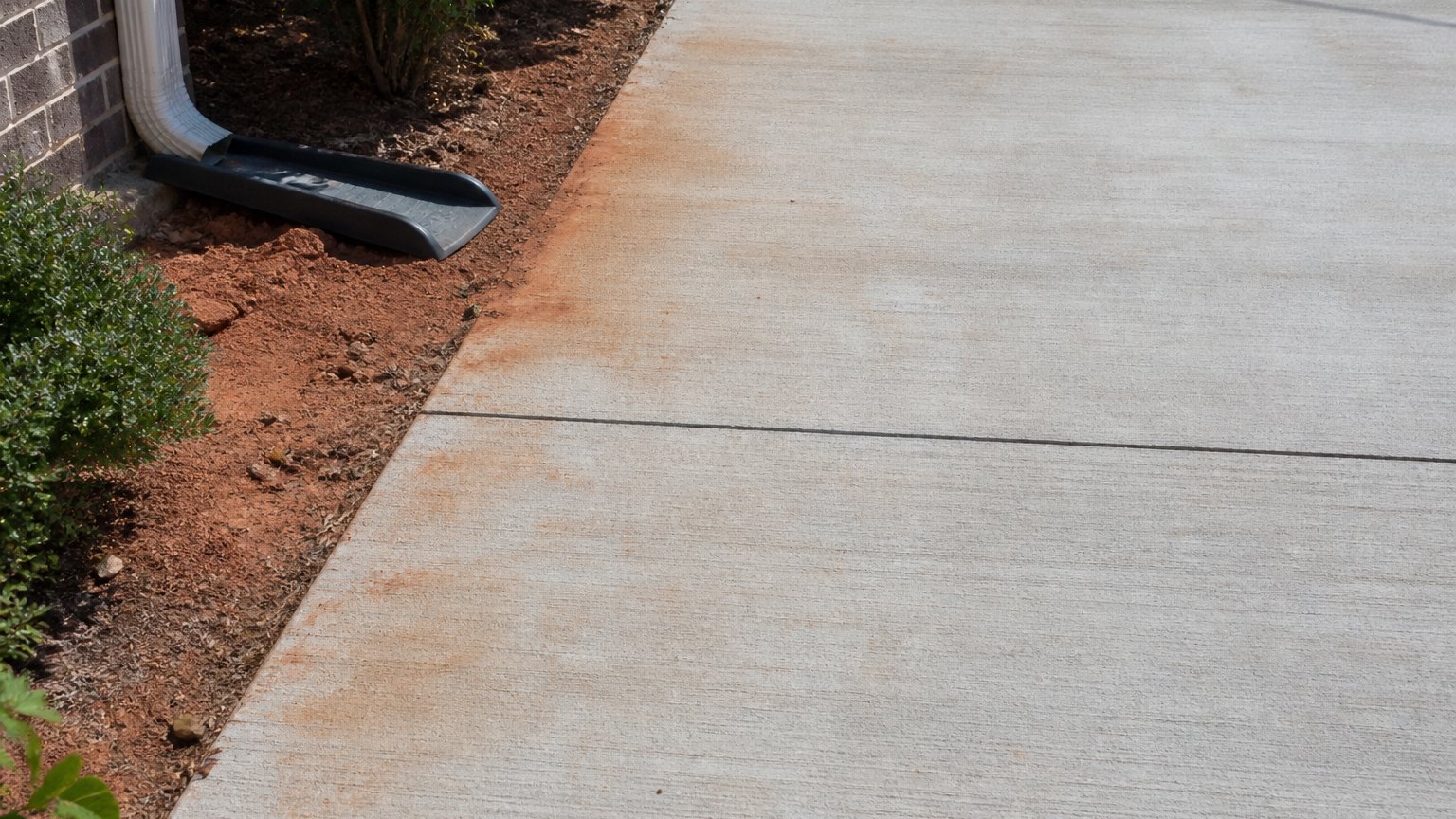
Here is the detail that matters on this soil. Cecil soil, the red Piedmont clay found on many lots around here, is high in iron oxide, and on light-colored concrete it leaves rust-toned staining wherever runoff crosses the slab: beside beds, below downspouts, at the low edge of a lawn. On black asphalt the same runoff barely shows. If you love a clean, pale drive, plan the grading, the downspout discharge and the sealer together, because the clay will find any unprotected edge.
Asphalt answers the climate with its coating. The EPA notes that asphalt is a petroleum-derived binder mixed with sand or stone, and that it lightens over time as the binder oxidizes and more aggregate is exposed through wear. That weathering is the reason owners sealcoat it, which brings its own schedule, covered below.
Is concrete or asphalt hotter in the summer?
New concrete generally runs cooler than asphalt on the surface because it reflects more sunlight, though the U.S. EPA notes both conventional surfaces can reach 120 to 150 °F at the summer peak.
The EPA's Cool Pavements chapter, part of its heat-island compendium, explains the mechanism. Solar reflectance, the share of sunlight a surface bounces back, is the main thing that sets a pavement's maximum temperature, and conventional asphalt and concrete fall between 5 and 40 percent. The agency notes that new concrete has a high solar reflectance and is generally considered a cool pavement, but loses reflectance over time as traffic dirt darkens it. Asphalt moves the other way, starting dark and lightening as it wears.
How much does reflectance matter? The same chapter cites Lawrence Berkeley National Laboratory researchers estimating that every 10 percent increase in solar reflectance could lower surface temperature by about 7 °F.
Upkeep: sealer on concrete, sealcoat on asphalt
Asphalt's routine maintenance is sealcoat, the black liquid sprayed or painted onto driveways to protect and refresh the surface. The U.S. Geological Survey's 2016 fact sheet on it is plain about the schedule:
"Applicators recommend reapplication of sealcoat from every 1 to 5 years."
U.S. Geological Survey, Fact Sheet 2016-3017, Coal-Tar-Based Pavement Sealcoat (April 2016)
The same fact sheet is worth reading before you hire anyone to seal an asphalt drive. It reports that most sealcoat products are either coal-tar or asphalt emulsion, that coal-tar-based sealcoat typically contains 50,000 to 100,000 mg/kg of polycyclic aromatic hydrocarbons against about 50 mg/kg for asphalt-based products, and that coal-tar sealcoat use is more common east of the Continental Divide except where it is prohibited. Tire friction wears sealcoat into fine particles that can be tracked indoors or washed into streams. If you keep asphalt, ask which product is going down.
Concrete has no equivalent recurring coating schedule; our driveway page describes a broom finish as needing no maintenance. We still recommend sealing here because of the clay staining and the freeze-thaw cycling, and decorative work benefits most because the sealer protects color and pattern too. How often to reseal depends on the product on your slab, its sun and traffic, and what it sits next to, so we give the interval for your surface rather than a chart number.
Repair and resurfacing: what each can be fixed with
A concrete drive that is still sitting flat has several repair options short of replacement. Cracks can be routed and sealed; a damaged section can be cut out at the joints and repoured; and a sound slab with a tired surface can take a resurfacing overlay. Our concrete repair page walks through which one fits which symptom. The test that decides it is whether the ground under the slab is still holding it up. A run of sunken panels, sections that rock underfoot and cracks that reopen wider each year mean the sub-grade has moved, and that is a replacement conversation.
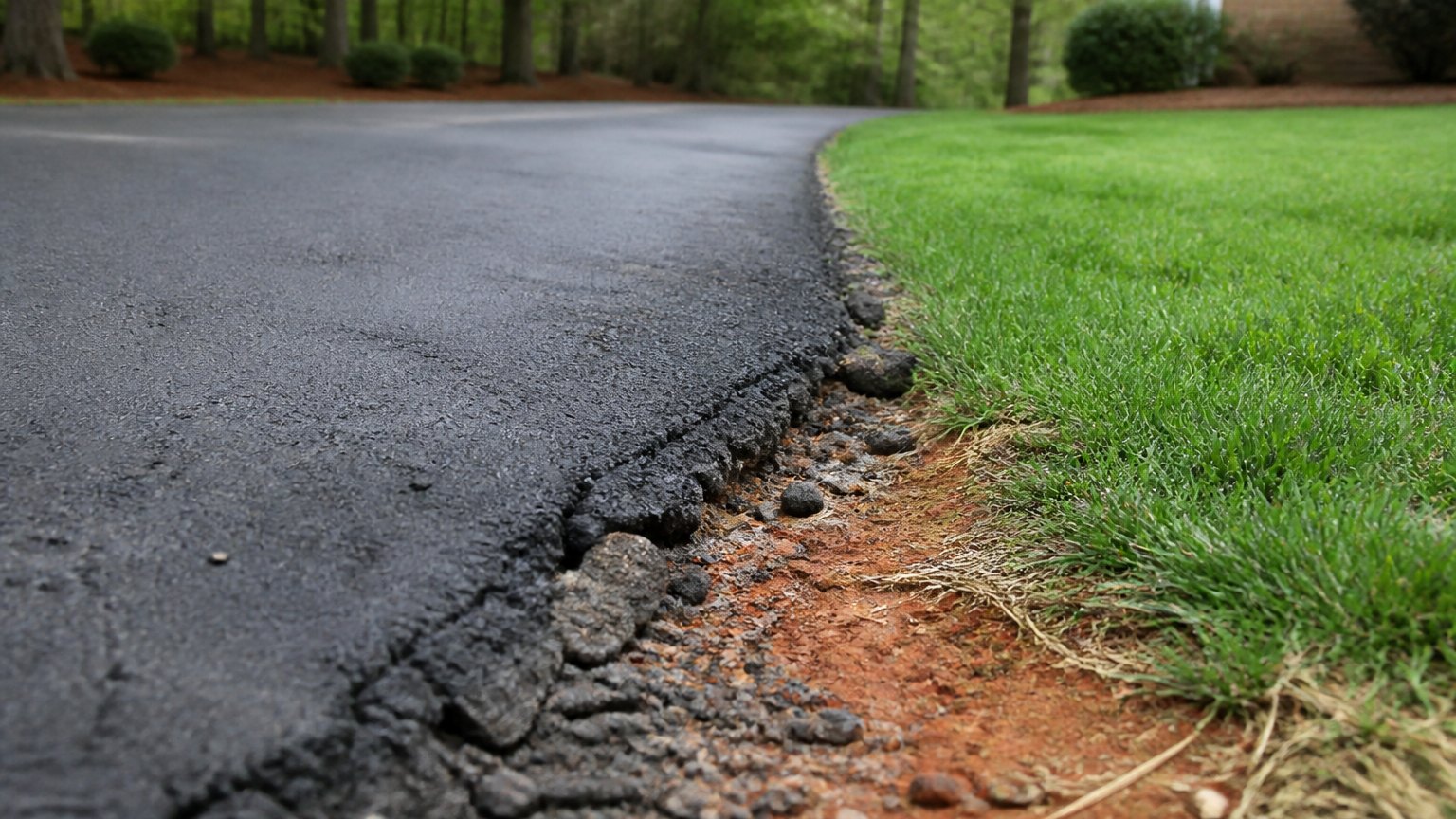
Asphalt is repaired with patching and sealcoat. We do not do that work, so we will not tell you how well it holds; ask an asphalt contractor for their method and their warranty in writing. What we can say from the concrete side is that an asphalt edge sitting on soft clay with no support has the same root problem as a concrete edge in the same spot. The surface is only as good as what is under it.
Switching an asphalt driveway to concrete
Replacing an asphalt driveway with concrete is a replacement job: the asphalt comes out and is hauled away, the sub-grade is cut back and recompacted, then forms go in and the concrete is poured.
- Tear-out. The old asphalt is broken up and goes straight onto a trailer. A drive full of loose material is not a place anyone can work.
- Sub-grade and base. We cut back to firm ground, to where the sub-grade should have been. Clay sets the pace here: an opened sub-grade has to be dry enough to compact before anything goes on it, which is why we give a replacement date as a week rather than an hour.
- Forms and joints planned. Forms are squared against the garage, the walk and the street, and the joint layout is set before the pour.
- Pour, finish, cure. Broom is the default finish. Stamped or exposed aggregate sit above it; our guide to a stamped concrete driveway on Piedmont clay covers what changes when you want a pattern.
- The apron. Replacing an apron in place generally does not need an NCDOT permit. Widening the entrance or cutting a new one onto a state-maintained road does, so raise it at the estimate.
Cost drivers, without a price list
We do not publish prices, because a price for a driveway nobody has walked is a guess. The factors that move a concrete number are tear-out, ready-mix truck access, what the sub-grade turns out to be, the finish, and the tie-ins at the street. Square footage matters least of the list, which surprises people. The published national ranges, each named to its publisher, are in the cost guide linked above.
Comparing quotes across the two materials is where homeowners get caught. An asphalt quote and a concrete quote are only comparable if they cover the same footprint, the same base work and the same tear-out. Ask each contractor to write down base depth and how it is compacted, what happens at the apron, and, for asphalt, when the first sealcoat is due and what it is made of. Then compare the cost of owning each surface over the years you expect to stay, not just the day it is finished.
When asphalt is the right answer
We pour concrete for a living, and we still tell some people to keep their asphalt or choose it. These are the honest cases:
- The existing asphalt is sound. If it sits flat, drains, and only needs sealing, replacing it with anything is spending money you do not need to spend yet.
- You are selling soon. If the drive only has to look tidy for a listing, a full concrete replacement may not pay you back.
- You would rather not see stains. Black hides red clay and oil drips. A pale concrete drive shows both until it is cleaned and sealed.
- The community expects it. Some neighborhoods have covenants or a street of matching drives; check before you change the look of the frontage.
- The asphalt quote is far lower on a very long run. On a long rural drive, the gap between quotes can outweigh everything else in this guide. Compare ownership costs, then decide.
If none of those fit and you want a surface that takes a finish, reflects more sunlight when new, and has no recurring sealcoat schedule, concrete is the case we would make.
Questions about concrete vs asphalt driveways
What comes up when a homeowner is choosing between the two.
Which lasts longer, a concrete or an asphalt driveway?
Is concrete hotter than asphalt in the summer?
Can an asphalt driveway be replaced with concrete over the old base?
Which driveway is cheaper to maintain in North Carolina?
Is a concrete or asphalt driveway better for red clay soil?
Is sealcoat safe to use on an asphalt driveway?
Does a concrete driveway crack more than asphalt?
Sources
- U.S. Environmental Protection Agency, Reducing Urban Heat Islands: Compendium of Strategies, Cool Pavements (2012).
- National Association of Home Builders and Bank of America Home Equity, Study of Life Expectancy of Home Components (February 2007).
- U.S. Geological Survey, Fact Sheet 2016-3017, Coal-Tar-Based Pavement Sealcoat: Potential Concerns for Human Health and Aquatic Life (April 2016).
- NOAA National Centers for Environmental Information, U.S. Climate Normals 1991-2020, Charlotte Douglas AP (USW00013881), days at or below 32 °F and at or above 90 °F, retrieved 2026-10-09.