
Lifting a sunken slab, or replacing it
One number explains why this question is worth asking before anybody books a tear-out.
Published 2026 figures put most residential concrete-lifting jobs at $500 to $3,000, against $2,000 to $10,000 for full slab replacement. Per square foot, mudjacking runs $3 to $8 and polyurethane foam $5 to $25. So when lifting is appropriate, it is not a marginal saving — it is a different order of expense, and it happens in hours rather than days with nothing torn out and hauled away.
The catch is in that word appropriate. Lifting corrects the position of a slab. It does not repair a slab, and it does not fix whatever caused the void underneath. A settled but otherwise intact panel is an excellent candidate. A slab that has broken into pieces is not, no matter how neatly the pieces could be raised.
Why slabs settle on Piedmont clay
Almost every sunken slab around Lake Norman comes down to the same thing: something happened to the ground underneath, not to the concrete.
Cecil clay swells when it takes water and shrinks when it dries. A slab bridging ground that goes through that cycle season after season is being supported unevenly, and eventually part of it loses contact with what is beneath it. Once there is a void, the slab is a bridge, and it settles into the gap or cracks across it.
The usual accelerants are all water. A downspout discharging beside a slab, a gutter that overshoots, an irrigation head throwing against an edge, or a grade that falls back toward the house rather than away from it — each of them concentrates water in one place and washes fines out from under the concrete. That is why fixing the drainage matters as much as fixing the slab: lift a slab and leave the downspout where it is, and you have bought time rather than a repair.
Poorly compacted backfill is the other common cause, and it is why slabs beside a foundation, over a utility trench, or on the fill half of a cut-and-fill lot are over-represented in this kind of job.
Mudjacking against polyurethane foam
Two established methods, and the cheaper one is not automatically the better value.
| Mudjacking | Polyurethane foam | |
|---|---|---|
| Cost | $3 – $8 / sq ft | $5 – $25 / sq ft |
| What is injected | A cement, sand and water slurry | High-density expanding foam |
| Weight of the fill | Roughly 100 – 150 lb per cubic foot | About 2 – 4 lb |
| Hole size | Larger drilled holes | Dime-sized holes |
| Cure | Longer | About 15 minutes |
| Published service life | Around 5 – 10 years | Around 10 – 15 years |
The weight line is the one that matters most and the one most often skipped. Mudjacking fills the void with a heavy slurry — and on ground that settled because it could not carry what was already on it, adding a hundred-odd pounds per cubic foot is a real consideration. Published guidance is fairly consistent that this is why mudjacked slabs can settle again, and why foam, at roughly a fortieth of the weight, tends to be treated as the better long-term option despite the higher cost.
Foam also cures in about fifteen minutes, so a drive can be back in use the same day, and it goes in through much smaller holes. Mudjacking's advantage is straightforward: it costs less up front, and on a large area of low-consequence flatwork that can be the sensible trade.
When lifting is the wrong answer
This is the part that a company selling only lifting has no reason to tell you.
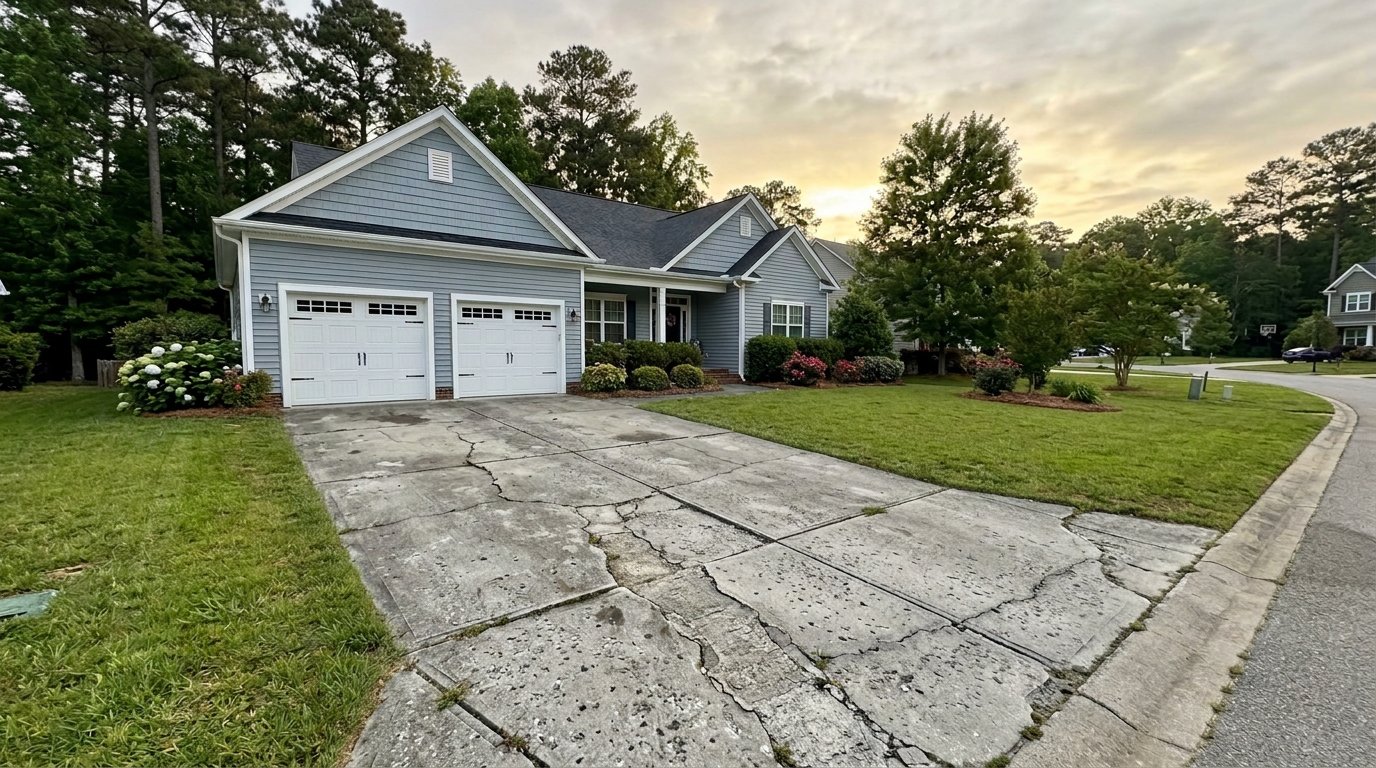
Lifting is a bad buy when the slab itself has failed. Concrete that has broken into several pieces, that is spalling and flaking across the surface, or that is riddled with cracks in more than one direction is not a slab that will behave as one panel when it is raised — it is a set of fragments, and raising them tends to produce a level surface made of visibly separate pieces. Published guidance and our own position agree here: at that point, replacement is the honest recommendation.
It is also the wrong answer when the cause is still running. If the void was washed out by a downspout, the drainage gets corrected first or the slab will be back where it started. And where a slab has settled because it was poured on a base that was never adequate, lifting treats the symptom of a problem that a proper re-grade and re-pour would end.
Our concrete repair page sets out how we assess this on site, and the repair, resurface or replace guide applies the same reasoning to a whole driveway rather than a single settled panel.
Sunken slab questions.
The ones that decide between lifting and replacing.