
Decorative concrete is concrete finished to look like more than a gray slab: patterned, colored, textured or resurfaced. Around Lake Norman it comes down to four systems, stamped, stained, exposed aggregate and overlay, and Carolina Custom Concrete installs all four on patios in Huntersville, Cornelius, Davidson, Mooresville, Denver and north Charlotte.
The four get sold as if they were a menu of looks. They are not. Two of them happen on the day of the pour, one happens a month later, and one goes over a slab that has been there for years. That timing, more than the photo you saved, decides which ones are even possible on your patio. The rest of this guide is about that, about what each one asks of you once it is down, and about how the decision actually gets made standing in your backyard.
Key Takeaways
- Two systems belong to a new pour. Stamping and exposed aggregate are done while the concrete is still plastic, on the day it is placed.
- Stain waits for cured concrete. SureCrete's acid stain data sheet calls for concrete "fully cured, 28 days" before it goes on, and says every slab stained with it must be sealed.
- An overlay needs a sound slab. SureCrete's SureStamp overlay goes down 1/4 to 3/8 in. thick and inherits whatever the old concrete is doing, cracks included.
- Each of the four depends on its sealer, and for stamped work the Decorative Concrete Council says to reseal as needed, not on a calendar.
- Charlotte averages 58.3 nights a year at or below 32 °F (NOAA 1991-2020 normals), which is why the surface layer and its sealer matter so much here.
Four systems in one table
This is the comparison the rest of the article unpacks. The columns that matter are the first two: when the work happens, and what it has to go on. A finish that needs a fresh pour is off the table for a patio you want to keep, and a finish that needs a sound slab is off the table for one that has settled.
| System | When it happens | Goes on | What you see | Sealing | The catch |
|---|---|---|---|---|---|
| Stamped | Pour day, while the slab is plastic | New concrete only | Slate, brick, paver, tile, stone or wood-plank pattern; pigmented base plus accent color | Film-forming sealer brings the color up; reseal as needed | Joints have to be planned into the pattern before the pour |
| Stained | After a 28-day cure (SureCrete VIVID data sheet) | New or existing sound concrete | Mottled, translucent color in the surface; no pattern unless the slab is saw-cut into a grid | Required on VIVID-stained concrete (same data sheet) | Shows every patch, trowel arc and old crack underneath |
| Exposed aggregate | Pour day, surface washed off to reveal the stone | New concrete only | A field of stone with strong grip | Covered in our exposed-aggregate guide | Rougher underfoot and harder to sweep |
| Overlay | Any time on cured concrete; 50 to 90 °F for 48 hours (SureStamp data sheet) | Existing, structurally sound slab | Anything from a plain new-looking surface to a stamped pattern, 1/4 to 3/8 in. thick for SureStamp | Exterior acrylic sealer required on SureStamp | Cannot fix settlement; must not bridge a joint |
The broader question of which finish suits a driveway versus a patio versus a pool deck on red clay is already covered in our guide to concrete finishes on Huntersville clay. This one assumes you have settled on a patio and want it to look like something.
Stamped concrete: the pattern goes in on pour day
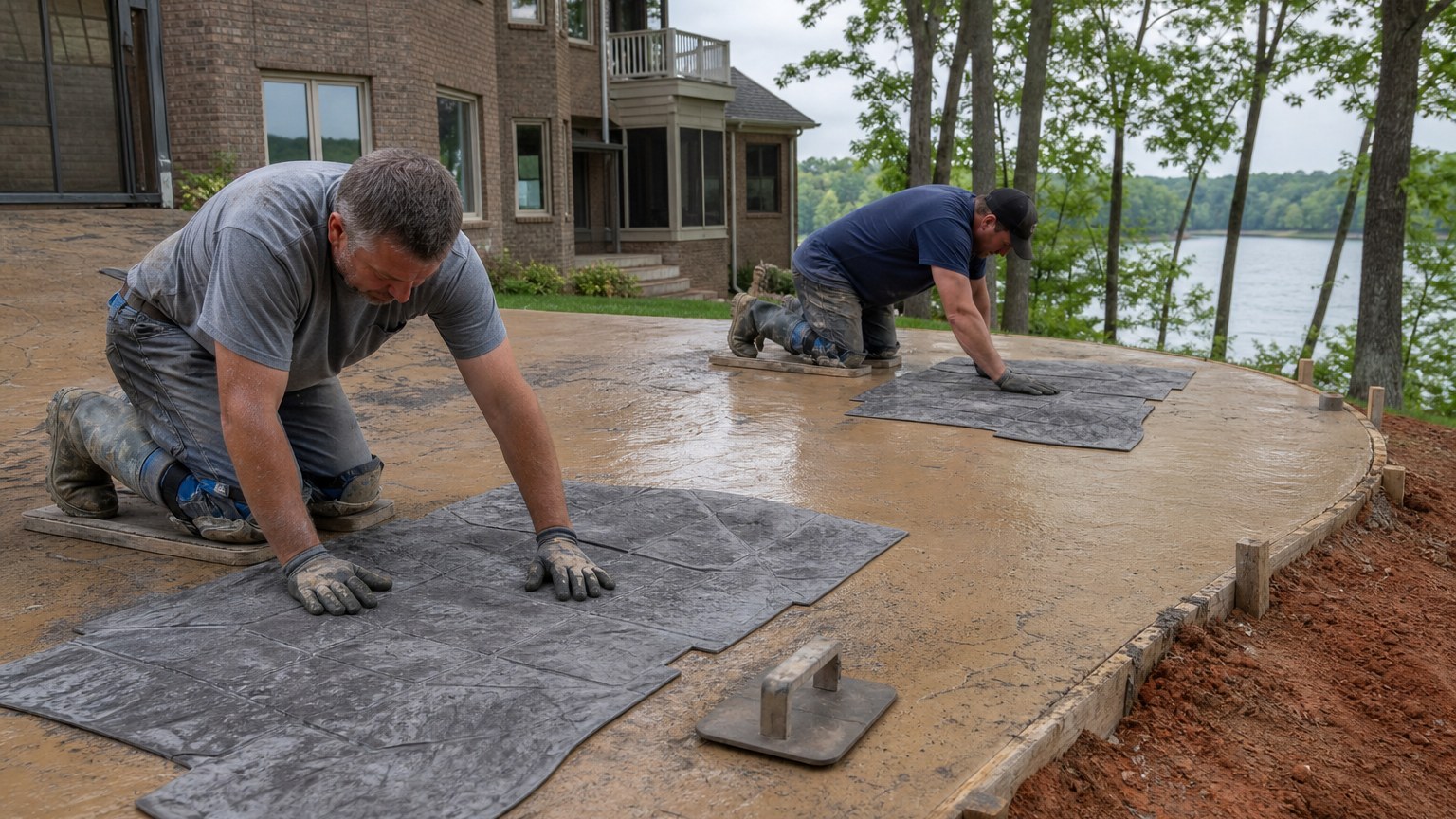
Stamping is texture pressed into concrete in the short window after it has been placed and floated and before it sets. On our jobs that means polyurethane stamp mats in slate, brick, paver, tile, stone or wood-plank patterns, laid in sequence across the slab and tamped in. Color comes in two layers. The base pigment is matched to whatever the pattern is imitating, and an accent color settles into the low points of the texture and does the job a mortar line does in real masonry. Without the accent, a stamped field reads flat.
The part people do not see coming is the joints. All concrete moves, and control joints decide where it opens. On a plain broom slab they can go on a tidy grid. On a stamped concrete patio they have to be planned against the pattern, and on a slate or flagstone stamp they can often be hidden along a pattern line. That decision is made before the truck arrives, not after.
Because the pattern is pressed into the slab itself, stamping is only for new concrete. If the patio you want to change is already there, the stamped look comes from an overlay, further down.
Stained concrete: color that waits a month
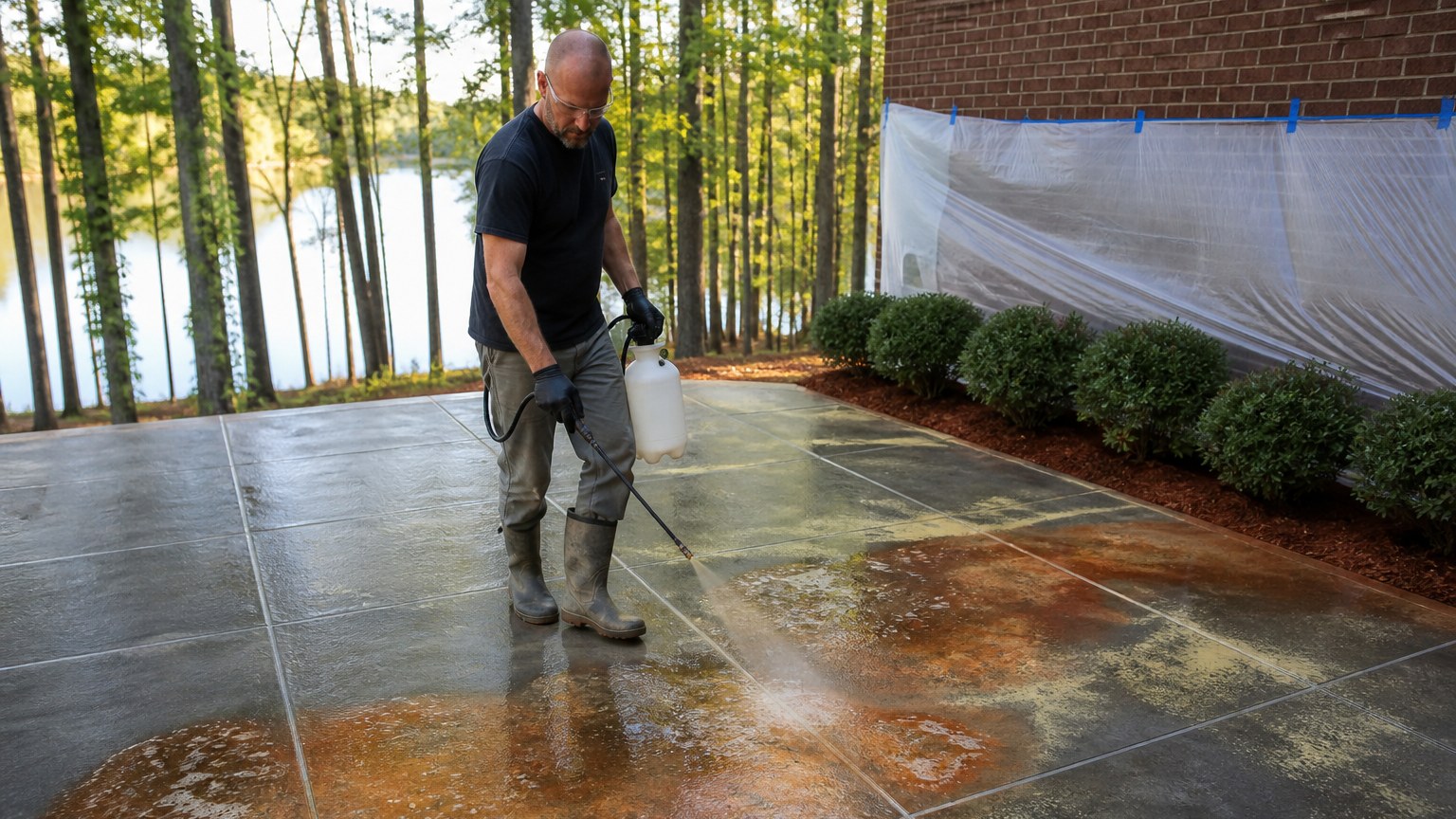
An acid stain is a mild acid carrying metallic salts. It reacts with the lime in the concrete and leaves a variegated earth-tone color in the surface rather than on top of it, which is why it does not peel the way paint does. Water-based stains and dyes do not react; they penetrate, which gives a wider palette and a more even tone. Our stained concrete page covers the differences between them.
The timing is the part that changes your project plan. SureCrete's VIVID Acid Stain data sheet says concrete should be "fully cured, 28 days" before the stain goes on, and warns against acid-etching the surface first because that "may inhibit a reaction." So on a new patio, the pour and the stain are two visits about a month apart. The same sheet recommends staining "in early morning when concrete is coolest" in warm weather, which on a Lake Norman patio in July is not a small note.
Stain is also honest to a fault. Every patch, trowel arc, old crack and patch of soaked-in sealer takes it differently. On a new pour that variation is the design. On a slab with a history it is a conversation to have on site before anything is quoted, and sometimes the right answer is an overlay first and a stain on top of that.
Exposed aggregate: the stone was always in there
Exposed aggregate adds no color or pattern layer. The surface paste is washed off on pour day to reveal the stone in the mix, or seeded stone pressed into it. The result grips well when wet and hides wear and red-clay staining better than a smooth surface. The wash-off timing, stone choice and sealing schedule all have their own guide: exposed aggregate concrete around Lake Norman. For this comparison the one fact that matters is that, like stamping, it belongs to a new pour.
Overlays: a new surface on the slab you already have
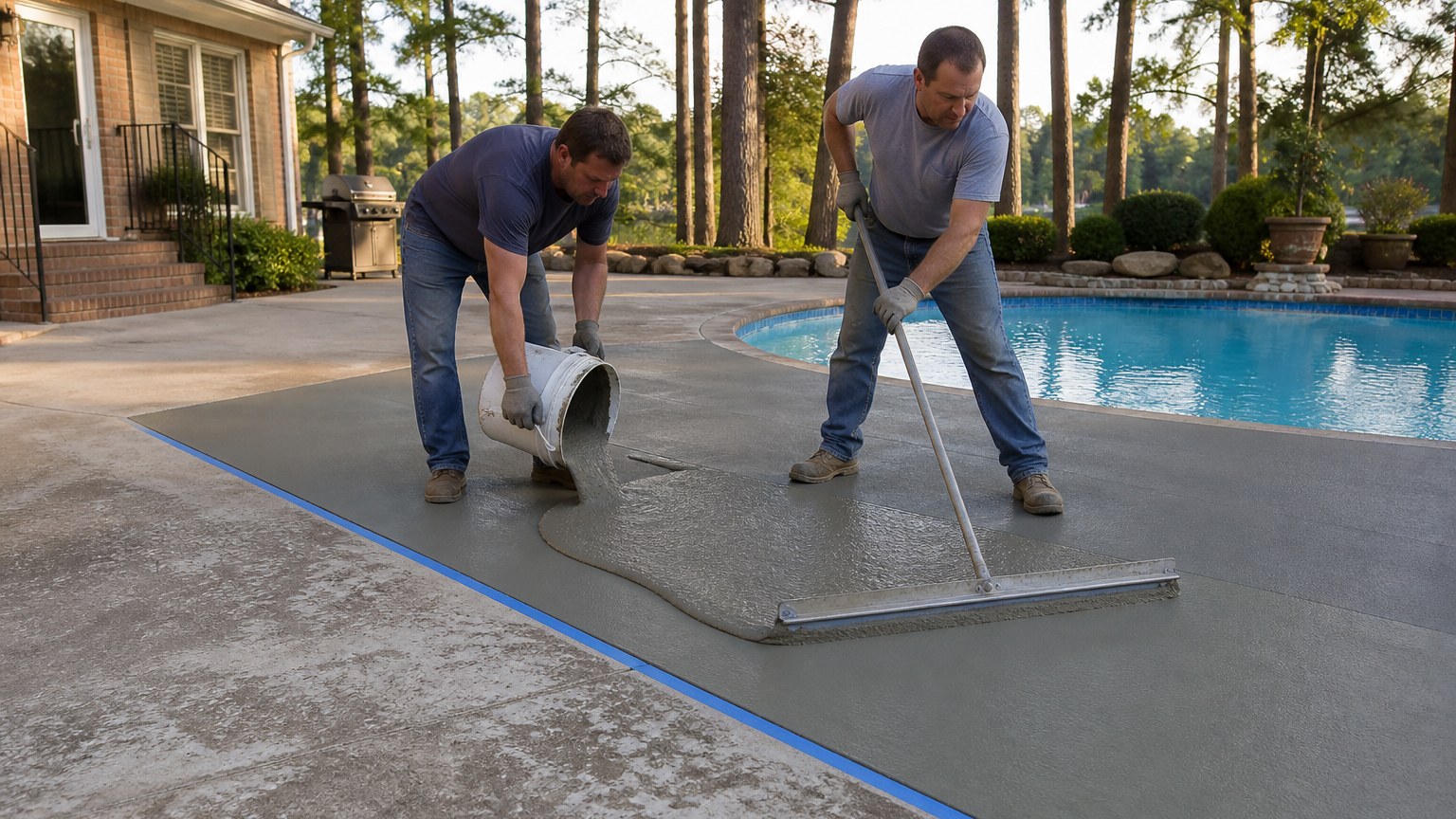
An overlay is a cementitious surface bonded onto existing concrete. It can be finished to look like a clean new pour, textured for grip, or stamped and colored so the old patio reads as slate or brick. It skips the tear-out, the haul-away and the new sub-grade, which makes it worth a look when you like your patio's size and dislike its surface. Our resurfacing and overlays page has the full finish range.
For scale, SureCrete, whose WallStamp and WallSpray systems we use on vertical work, specifies its SureStamp stampable overlay at 1/4 to 3/8 in. (6.35 to 9.5 mm). Its data sheet sets hard rules that explain why overlays succeed or fail:
- The old slab must be clean, cured, sound and profiled. Nothing goes over concrete that is "flaking, spalling, or has hibernating spalling."
- Air and surface temperatures stay between 50 °F and 90 °F during placement and for 48 hours after, with no rain in that window.
- Initial set comes in 6 to 8 hours; full cure, like concrete, at 28 days.
- "Never bridge SureStamp across any joint in concrete." Joints move, and the movement telegraphs straight through a thin topping.
- Exterior jobs are sealed with an acrylic sealer "due to its vapor permeability."
That temperature window meets local weather head-on. NOAA's 1991-2020 normals for Charlotte Douglas Airport average 49.2 days a year at or above 90 °F. A midsummer overlay is not impossible, but its timing has to be chosen around the heat rather than the calendar.
The bigger limit is the slab itself. An overlay adds no structural capacity and cannot stop settlement. Laid over concrete that has sunk or cracked through, it cracks again along the same lines, usually within a season. That is why the sound-slab test further down comes before any overlay quote.
Broom and salt finishes: the plain options people skip
Not every patio needs a decorative system. Broom is the finish we pour most, by a distance, because it grips, wears hard and costs the least. On a patio that will live under outdoor furniture and a rug, a clean broom finish with a neat joint layout is a legitimate choice, and a good sealer helps it resist staining.
A salt finish sits between plain and decorative: coarse rock salt is pressed into the fresh surface and washed out after the concrete sets, leaving a scatter of shallow pits. It is not one of the finishes on our service pages, so if you like the look, raise it on the site visit rather than assuming it is the right call. The pits hold water, and with 58.3 freezing nights a year on the Charlotte normals, what freezes in them works on the surface.
What each finish needs for sealing
Sealing is where decorative concrete is won or lost over the years. A sealer on decorative work is protecting the expensive layers: the pattern, the accent color, the stain. It also slows the iron-oxide staining that red clay leaves on untreated concrete, which our cleaning and sealing page explains in more detail.
The American Society of Concrete Contractors' Decorative Concrete Council puts the maintenance rule plainly in its March 2025 best-practice sheet:
"Reseals should be performed on an 'as needed' basis rather than at a set number of years."
ASCC Decorative Concrete Council, Sealing Stamped Concrete, Concrete International, March 2025
The same sheet notes that loss of water and stain repellency and loss of color depth are the main reasons to reseal, and that resealing more often than needed builds up a film that is "time-consuming and expensive to remove." It also says the best time to apply is when "the slab temperature will be falling for 3 to 4 hours after application," which "may require that applications are limited to evening hours." That is the same heat problem as the overlay window, from the other side.
By system, the practical differences look like this:
- Stamped: a film-forming sealer is what brings the base and accent colors up; the DCC sheet notes these are the most used option on stamped work "due to their color-enhancing properties." Any release powder left on the surface has to be cleaned off first, or the sealer fails.
- Stained: sealing is not optional. The VIVID sheet says all concrete stained with it "must be sealed," and that different sealers change how intense the color looks.
- Exposed aggregate: its own schedule, set out in the exposed-aggregate guide.
- Overlay: sealed as part of the job; SureStamp calls for an exterior acrylic because it breathes.
How often your patio will need it depends on the product on the slab, the sun it takes and the traffic it carries. We give you that interval for your surface rather than a number off a chart, which matches the DCC's as-needed advice for stamped work.
How the finish gets chosen on a site visit
Pattern and color are easier to decide standing on the space than looking at a screen, and the site visit settles the question the photos cannot: new pour or existing slab. If the patio is new, or the old one is coming out, all four systems are open. If the patio stays, stamping and exposed aggregate are off the table, and the choice is between a stain, an overlay, or both.
For an existing slab, the deciding step is the sound-slab test from our resurfacing page. It is done standing on the slab:
- Walk every panel and feel for rocking.
- Look at the joints for a step between neighboring panels.
- Check whether water sits anywhere it should be draining. If a hose is handy, water on the slab shows in a minute where the fall has gone.
- Look at every crack for width and age. A crack with clean, sharp edges that has not widened is stable. One that is wider than it was, or has rounded, weathered edges with dirt worked into it, has been moving.
A slab that passes, flat, still, draining, with only stable cracks, is a candidate for an overlay or a stain. A slab that fails on any one of those is a repair where the failure is local, or a replacement where it is not, and no decorative surface changes that. We will tell you which one you have, including when the answer costs us the job.
After that come the choices people expect: which pattern, which base and accent color against your brick or siding, and whether the patio should match a driveway or pool deck poured later. Choosing them together is easier than matching work done two years apart. Our stamped and decorative concrete page shows the pattern families and finished work around the lake.
Questions about decorative concrete
What comes up once the four systems are on the table.
What are the main types of decorative concrete?
Can I get a stamped look on my existing patio?
How long after a pour can concrete be stained?
Which decorative finish is best for a lakefront patio?
Does decorative concrete need to be sealed?
Will an overlay hide cracks in my patio?
Is a salt finish a good idea around Lake Norman?
Sources
- NOAA National Centers for Environmental Information, U.S. Climate Normals 1991-2020, Charlotte Douglas AP (USW00013881), annual days with minimum at or below 32 °F and maximum at or above 90 °F, retrieved 2026-09-25.
- American Society of Concrete Contractors, Decorative Concrete Council, Best Practices in Decorative Concrete: Sealing Stamped Concrete, Concrete International, March 2025.
- SureCrete, SureStamp interior/exterior stampable overlay, technical data sheet (dated 07/10/2017).
- SureCrete, VIVID Acid Stain, technical data sheet.