
Key takeaways
A slab gets poured here when three conditions line up on the same morning: the sub-grade is dry enough to compact, the mix will leave the chute under 95 °F, and the slab has a run of nights above 40 °F in front of it. Two out of three is not good enough, and none of the three is visible in a phone weather app. That is why a concrete contractor in Lake Norman gives you a week for your pour date rather than an hour, and why the week sometimes moves after you have already cleared the driveway.
- The study guide NCDOT certifies concrete field technicians against puts the mix at no more than 95 °F when it goes into the forms, and ACI arrives at the same figure at discharge. NOAA’s normal daily high for July at Charlotte Douglas is 90.3 °F — so on a Piedmont summer afternoon that ceiling is a scheduling problem, not a rare event.
- Rain moves a pour by days, not hours, because the thing that has to dry is not the surface. It is the red clay under the stone base.
- A calendar day is not a curing day. NCDOT only counts a day toward cure if the air next to the slab never drops below 40 °F, which quietly stretches a December pour’s protection schedule.
- Cecil clay moves seasonally, but the USDA rates its shrink–swell potential Low, not high. The recurring failures on a Lake Norman lot start with water and compaction rather than with the ground lifting a slab.
- The two best pour windows on Lake Norman are roughly April into May and late September into October. Everything else is workable with a plan and a different start time.
The 95 °F ceiling is a July Tuesday here, not an emergency
The number the trade is bound by is not the one on your porch thermometer.
Homeowners assume the temperature that matters is the one on the porch thermometer. The number the trade is actually bound by is the temperature of the concrete itself, measured as it comes out of the truck. North Carolina’s Department of Transportation states it plainly in the study guide it trains and certifies concrete field technicians against:
“Make sure the concrete temperature at the time of placement in the forms is not less than 50 °F nor more than 95 °F.”NCDOT Materials & Tests Unit, Concrete Field Technician Study Guide
The American Concrete Institute lands on the identical figure. ACI 301-20 and ACI 305.1-14 both limit fresh concrete to 95 °F at discharge for ordinary work — pavements, buildings, bridges — with anything above that requiring past field experience or preconstruction testing submitted to the engineer first. Be clear about what these documents are: NCDOT’s version binds NCDOT contracts, ACI’s is a voluntary consensus standard, and neither is law for a residential driveway. What they are is the number the whole trade calibrates to.
Now put that against the local climate. NOAA’s 1991–2020 US Climate Normals for station USW00013881, Charlotte Douglas International Airport, put the normal daily maximum air temperature in July at 90.3 °F, with August the wettest month of the year at 4.35 inches of precipitation. Concrete does not arrive at ambient temperature — it arrives warmer. Cement hydration is exothermic, the aggregate has been sitting in an uncovered stockpile in the sun, and the mix water in an above-ground tank in August is nowhere near cold. Add those together on a 90 °F afternoon and the mix is knocking on 95 °F before anyone has done anything wrong.
What that does to the job is not abstract. Hot concrete sets faster, which compresses the window between screeding and finishing, pulls the saw-cutting schedule forward into the evening, and raises the risk of the surface skinning over and cracking while the slab underneath is still plastic. Which is why summer flatwork in the Piedmont gets booked for a morning slot and the truck is ordered early. Not for anybody’s comfort. For the mix.
What the calendar looks like from the truck
| Month | Normal daily high (°F) | Normal precipitation (in) | What it means for a pour day |
|---|---|---|---|
| January | 52.3 | 3.49 | Placement is fine; the overnight low decides whether the slab gets blankets |
| April | 73.2 | 3.84 | Widest window of the year — mix temperature is a non-issue all day |
| June | 86.9 | 3.99 | Morning pour; afternoon convection starts building storms |
| July | 90.3 | 3.74 | Morning pour only; the 95 °F discharge cap is genuinely in play |
| August | 88.6 | 4.35 | Wettest month — the sub-grade, not the heat, is what moves dates |
| October | 73.3 | 3.16 | Dry and mild — the other clean window |
Temperature and precipitation above are NOAA NCEI’s 1991–2020 US Climate Normals for station USW00013881, Charlotte Douglas Intl AP — the nearest long-record station to the Lake Norman towns.
The sub-grade decides the date, and it dries slower than your yard
When the yard looks ready and the pour still does not happen, this is why.
Here is the part almost nobody outside the trade knows. When it rains on Tuesday and the forecast is clear by Thursday, the yard looks ready and the pour still does not happen. The reason is what sits under a Lake Norman driveway.
The USDA’s official series description for Cecil — the series it maps right across the Piedmont uplands — describes a surface horizon of sandy loam only 2 to 8 inches thick sitting on a subsoil it records as “red (10R 4/8) clay… firm; sticky, plastic.” Excavating a driveway pad cuts straight through the friable topsoil and stops on that Bt horizon. That sticky, plastic clay is the material the base has to be compacted onto, and clay at high moisture content cannot be compacted. It deflects, it ruts, and under a loaded truck it pumps. Run a plate compactor across it wet and you have polished it, not densified it.
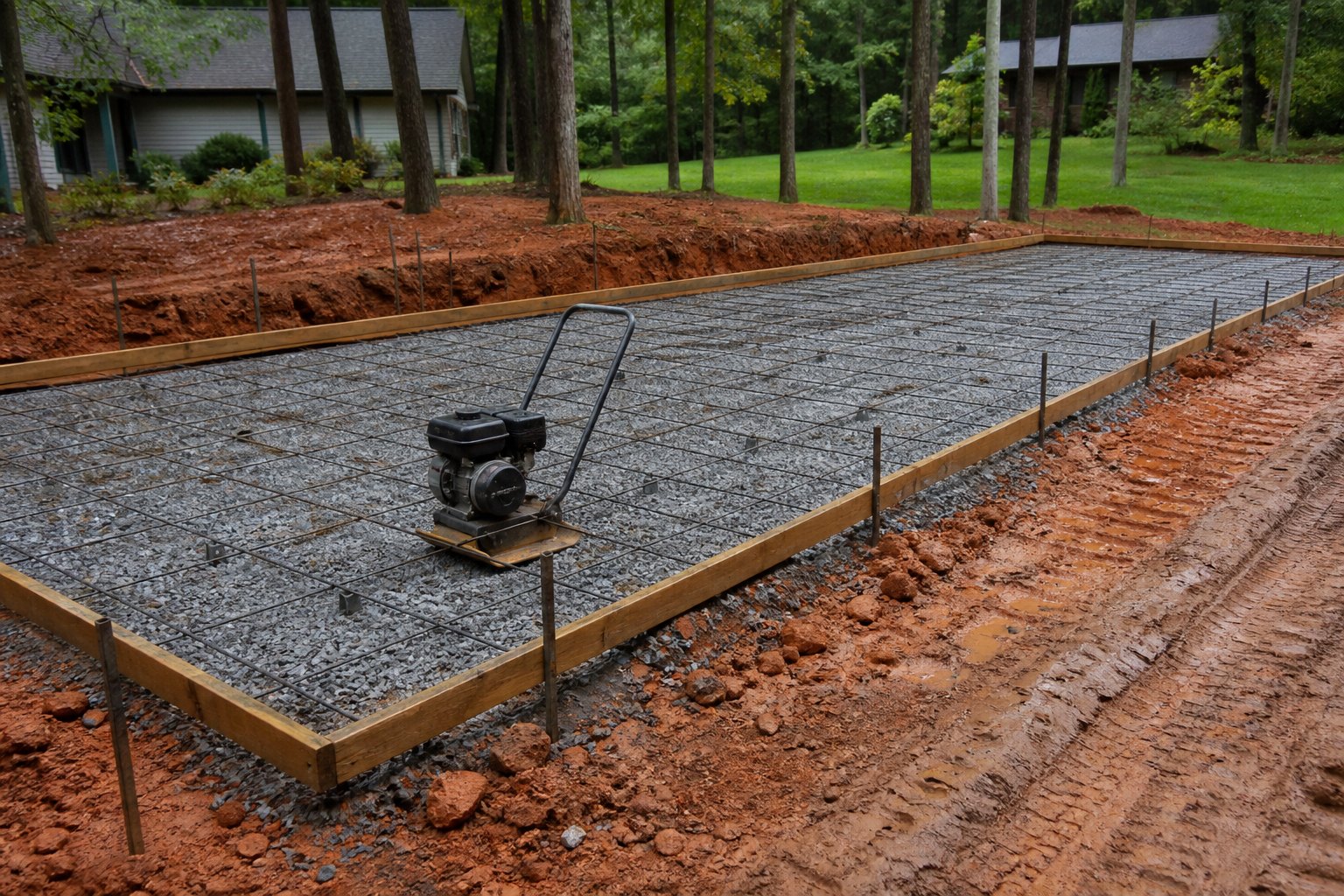
The same document lists a mean annual precipitation of 1,219 millimeters — 48 inches — but that figure covers the whole series, which the USDA maps across five states. Charlotte’s own number is lower: summing NOAA’s monthly normals for Charlotte Douglas gives about 43.6 inches a year. Either way, that is a great deal of water arriving on a soil whose subsoil is plastic clay, and it is the scheduling problem in one line. The tell a crew looks for is the proof roll: drive a loaded truck or a heavy roller across the prepared sub-grade and watch. Firm ground barely marks. Ground that is still holding water flexes visibly ahead of the tire and springs back behind it. If it pumps, the answer is another two or three dry days, or cutting the wet material out and replacing it with stone. It is never “pour anyway and hope.”
How much Cecil clay actually moves
“Shrink-Swell Potential: Low”USDA NRCS, Official Series Description — CECIL, revised 11/2025
This is worth saying out loud because so much online concrete advice is written for expansive-clay markets. Cecil moves seasonally like any clay soil, and the base and the jointing plan have to allow for that. But the USDA rates its shrink–swell potential Low rather than high, which puts it in a different bracket from the genuinely expansive soils of central Texas or the Front Range. The practical consequence is where a homeowner should aim their attention. The recurring problems on Lake Norman lots are a sub-grade that was never compacted properly, a base that lets water stand under the slab, and a finish rushed on a hot day — rather than a slab being lifted off the ground. Which is also why the finish choice matters less than people expect, a point worth reading alongside how clay soil should steer your finish.
A calendar day is not a curing day
The winter version of the problem is subtler than the summer one.
The winter version of this problem is subtler than the summer one, and it catches people who booked a December pour to get it done before the holidays. Concrete does not cure on a calendar. NCDOT defines the unit of cure explicitly:
“A curing day is defined as any consecutive 24 hour period, beginning when the manipulation of each separate mass is finished, during which the air temperature adjacent to the mass does not fall below 40 °F.”NCDOT Materials & Tests Unit, Concrete Field Technician Study Guide
Read that again with a Piedmont January in mind. The normal daily high at Charlotte Douglas in January is 52.3 °F, which sounds workable, and it is — for placement. But highs are not lows. A night that drops to 34 °F does not count toward cure at all under that definition, and the day it belongs to is spent rather than banked. That is the mechanism behind blankets and insulated curing covers on a winter slab: they are not decoration, they are how a January day is converted into a curing day. NCDOT’s other winter line is the placement floor — concrete is not to be placed when the air temperature is below 35 °F without permission.
The practical consequence for a homeowner is that the “when can I drive on it” answer stretches in the cold. We work through the general trade timelines and what moves them in how long before you can drive on new concrete, but the short version is that a slab poured in the third week of December is protected differently and released later than the same slab poured in April.
The three windows a Lake Norman crew is actually watching
Knowing which regime your job falls into tells you how firm your date is before you ever ask.
Across a year there are three distinct constraint regimes, and knowing which one your job falls into tells you how firm your date is before you ever ask.
| Window | Binding constraint | The number being watched | What it does to your date |
|---|---|---|---|
| June – early September | Mix temperature and afternoon convective storms | 95 °F at discharge | Pour is booked for the morning. A storm cell after finishing but before the surface has set can mark the slab, so the date can move on the day. |
| Late November – February | Overnight lows against the cure clock | 40 °F overnight; 35 °F placement floor | Placement is usually fine. Protection and release both stretch, so plan the return to service, not the pour, around it. |
| March – May, late September – October | Moisture in the clay sub-grade | Days of dry weather since the last real rain | The widest windows of the year, but a wet spell still pushes a date by two to four days, not by an afternoon. |
What to ask before you accept a pour date
Four questions separate a contractor scheduling around the ground from one scheduling around a calendar.
Four questions separate a contractor who is scheduling around the ground from one who is scheduling around a calendar. Ask what happens to the sub-grade if it rains between now and the pour — a real answer describes proof rolling and a decision rule, not “we’ll be fine.” Ask what time the truck is ordered for in July, because an afternoon slot in a Piedmont summer is a tell. Ask how many curing days the protection plan assumes if the job is in December. And ask what the slab is protected with overnight, not just whether it is.
Pour dates also ripple outward, which is the part people forget. If you have a mason booked to set stone on the seat walls, or a Charlotte hardscape contractor holding a date to lay the paver borders and build the outdoor kitchen once the pad is down, their crew is standing on a schedule that starts with yours. Give the downstream trades the week rather than the day, and tell them the moment the ground moves it. A patio build that loses three days at the front recovers. One that loses three days after the stone has been delivered and staged does not.
When waiting is the right answer
Some jobs should wait, and a contractor worth hiring will say so.
There is a version of this article that ends with “call and we’ll get it poured.” That is not the honest ending. Some jobs should wait, and a contractor worth hiring will say so. A driveway tear-out in the week after four inches of rain is one — the sub-grade under an old slab has been sheltered from evaporation and is often the wettest ground on the lot, which is a real issue on a full driveway replacement where the whole pad is opened at once. A large exposed pour with a line of storms on the radar is another. And a decorative stamped pour on a 92 °F afternoon is a third, because stamping needs a working window that heat takes away, and a rushed stamp is visible for the life of the slab.
None of that is unique to one town. It applies the same way on jobs in Cornelius, Mooresville, Denver and Concord, and on the ones that come through our Huntersville concrete work. What changes town to town is the lot: how much of it drains toward the pad, how much shade it holds through the morning, and how far a truck has to reach. Those are site-walk questions, not forecast questions.
Questions about pour dates.
What people ask once the date is on the table.