
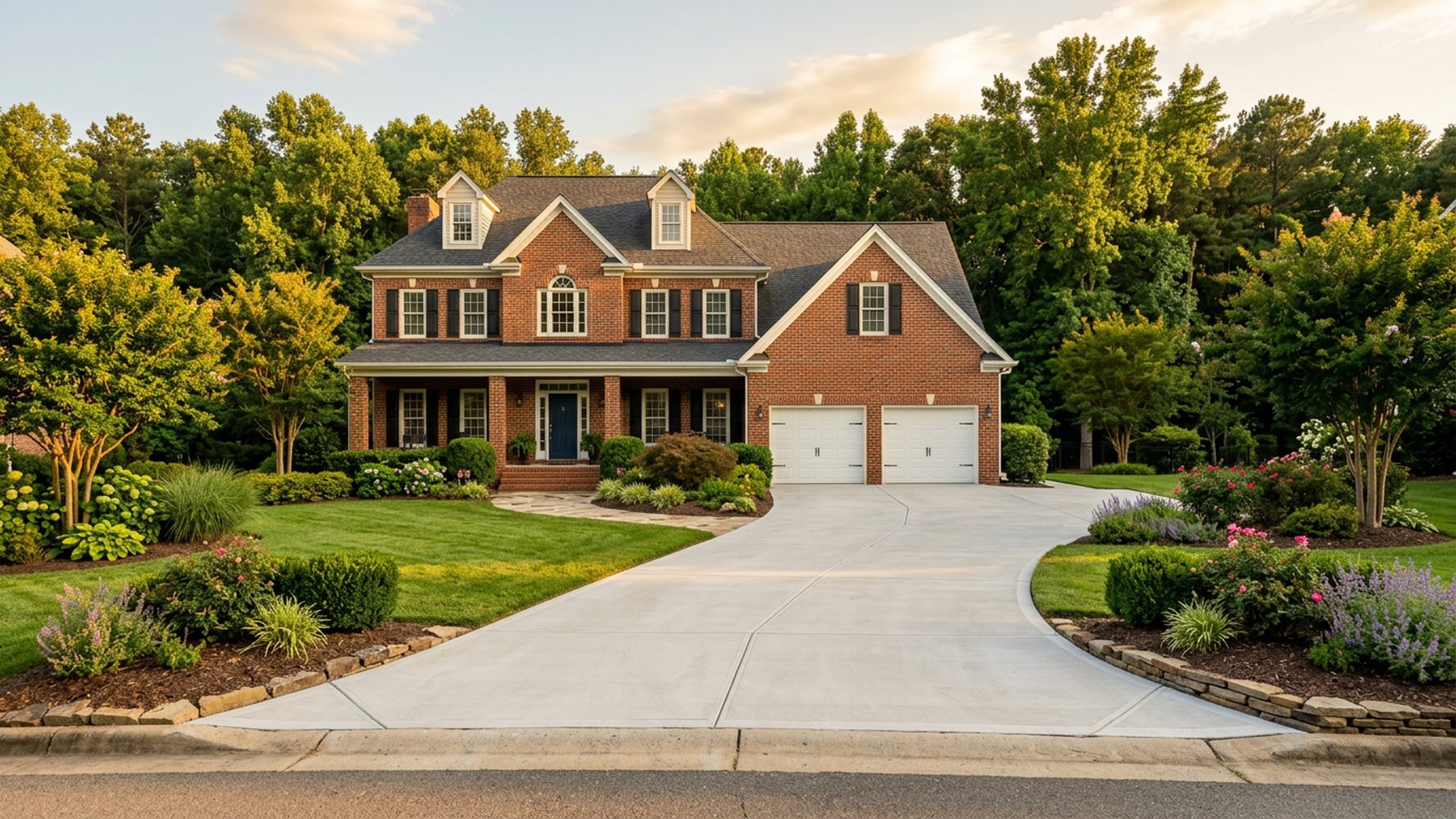
Pour the new driveway, patio or pool deck first and let it cure for 28 days. Then repaint the house with the slab covered, and seal the concrete last, once the painters have gone and the slab is clean and dry.
That order protects the two things that are hardest to fix: a young slab still gaining strength, and a fresh coat of paint. Carolina Custom Concrete pours driveways, patios and pool decks around Lake Norman, and these are the questions worth settling when a new slab and an exterior repaint land in the same year.
Key Takeaways
- Concrete first, paint second, sealer last. In our view, trucks, pump hoses and stone dust are rough on fresh paint, and a repaint is rough on an unsealed slab.
- Light foot traffic is fine early; ladders, lifts and scaffolds are not. Our cure-time guide puts walking at about 2 days and heavy vehicles and point loads at 28.
- Cover the slab, and ask how. EPA's lead rule requires plastic ground cover 10 feet out, or farther if debris would fall farther, unless a property line prevents it, when a paid renovation on a pre-1978 house disturbs lead paint. On any house it is a fair thing to ask for over new concrete.
- Seal after the painters leave. Cemstone and SpecChem both call for concrete at least 28 days old, and Cemstone adds clean, dry and between 50 and 80 °F.
- Check where the slab sheds water. In our view, a slab that drains onto lower siding can undo a new paint job.
The order of work, and why
Concrete is the heavy, messy trade: a ready-mix truck, a pump or chutes, wet concrete that splashes, a crew walking the edges of the house. Paint is the finishing trade, and putting it last keeps the finish clean. That is our view as the concrete crew. The table sets out the sequence we would plan, with the published figure behind each wait.
| Step | Wait or condition | Why | Source |
|---|---|---|---|
| 1. Repair soft wood near the slab line | Before the pour | A rotten sill or post base is easier to reach before a slab sits against it | Our judgment |
| 2. Pour the driveway, patio or pool deck | Foot traffic about 2 days, cars about 7, heavy loads 28 | Concrete keeps gaining strength after it is hard | Our cure-time guide, citing Concrete Network |
| 3. Prep and repaint the house | Ladders, lifts and scaffolds after 28 days where possible | A ladder foot is a concentrated load on a young slab | Our reading of the 28-day figure above |
| 4. Paint within the label's conditions | Air at least 5 °F above the dew point; no rain forecast for 8 hours | Wet or cold surfaces cure poorly | Diamond Vogel technical bulletin |
| 5. Clean, dry, then seal | Slab at least 28 days old, clean and dry; 50 to 80 °F (Cemstone); 1 to 2 days to dry after a pressure wash before a cure and seal (Euclid) | Sealer needs a bare, dry, cured surface | Cemstone; SpecChem; Euclid Chemical (2007 guide) |
If the slab is already more than a month old when you decide to repaint, the wait in step 3 has run out and you only need the protection below.
What the new slab is waiting for
New concrete does not dry, it cures: cement and water react and keep building strength for weeks. Our guide to how long before you can drive on new concrete cites Concrete Network's published figures of about 2 days for careful foot traffic, about 7 days for ordinary cars, and 28 days for heavy vehicles and concentrated loads.
A repaint brings the second kind of load. A ladder puts a person's weight on four small feet, and a scaffold or boom lift puts far more through a few base plates or wheels. We read the 28-day figure as covering those loads. That is a reading, not a published rule for ladders, so ask the crew that poured your slab for its date.
One more wait hides in the paperwork. A common way to cure a slab is a liquid curing compound, as Euclid Chemical's application guide explains. It says a dissipating compound can be cleaned off after 4 to 6 weeks, followed by a penetrating sealer, and that a penetrating sealer needs clean, bare concrete to soak into. Before the sealing step, ask what was used on your slab.
Protecting new concrete from the repaint
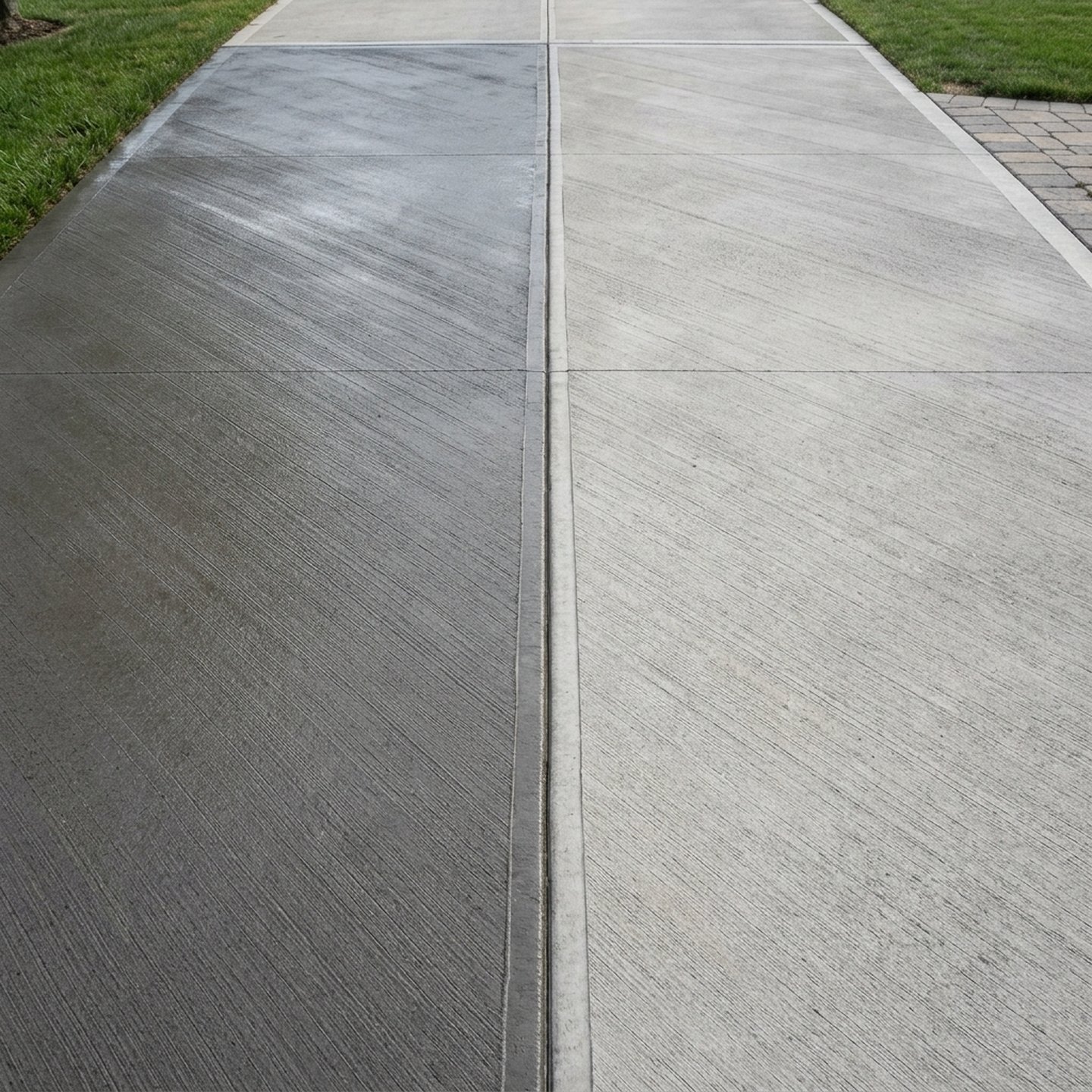
Three things reach a slab during a repaint: wash water, paint and primer, and foot and equipment traffic. Unsealed concrete is porous, and our concrete cleaning and sealing page explains that a sealed surface does not absorb rust-toned runoff the same way. We read the same logic as applying to drips: what would wipe off a sealed surface can stay in an unsealed one.
The best published model for covering the ground comes from EPA's lead rule, which applies to paid renovations of houses built before 1978. Its work-practice FAQ, retrieved 27 October 2026, reads:
"For exterior renovations, cover the ground with plastic sheeting or other disposable impermeable material extending 10 feet beyond the perimeter of surfaces undergoing renovation or a sufficient distance to collect falling paint debris, whichever is greater, unless the property line prevents 10 feet of such ground covering."
U.S. Environmental Protection Agency, RRP Rule work-practice FAQ
A house built after 1978 is outside that rule. The covering is still a reasonable requirement over new concrete, because falling debris is exactly what lands on a patio or driveway.
| Source of risk | What it does to a young slab | What to ask for |
|---|---|---|
| Wash water and cleaner | Runs across the surface and can leave a significant amount of water in the concrete even when it looks dry (Euclid) | Which products go in the wash water, and where the runoff goes |
| Paint, primer and caulk drips | Soak into porous, unsealed concrete | Drop cloths overlapped past the work area, checked daily |
| Ladders, scaffold, lifts | Concentrate load on a slab still gaining strength | Wait for 28 days, or boards under the feet and a go-ahead from the pour crew (our judgment) |
| Spray and wind | Overspray can travel past the drop cloth (our judgment) | No spraying in wind; hand-brush or mask the lower courses beside the slab |
Trim and siding: when the paint can go on
The paint has its own clock, set by the label, not by the slab. One manufacturer, Diamond Vogel, says in a technical bulletin retrieved 27 October 2026 that exterior latex should not be applied below 50 °F unless the product is formulated to go down to 35 °F, that the temperature should be at least 5 °F above the dew point, and that it should not go on if rain is forecast within 8 hours. Read the can for your product; the numbers differ by brand.
Your painter should be working to the same conditions. One local option among the exterior painters in Charlotte, NC is Chris' Painting & Remodeling, a family-owned contractor based in Monroe that lists Huntersville and Lake Norman among its service areas. Its exterior page describes washing and scraping first, cutting out rotten wood instead of painting over it, and spot-priming bare wood the day it is exposed, and it says spring and fall are the easy windows and that the constraint is surface temperature and dew rather than the calendar.
Whichever painter you choose, two questions belong in the quote. Where will the ladders and drop cloths sit, given the new slab? And how will wash and rinse water be kept off it? A specific answer is a good sign. A vague one is a reason to ask again.
Before the first coat, look at where the new slab sheds water. Our driveway guide describes a driveway pitched away from the garage and house, and our patio page says a patio has to shed water away from the house. A slab that sends water back toward the foundation wets the lower siding and trim, and Chris' page lists peeling near the ground as a moisture symptom to trace before repainting. Fix the fall first.
Sealing, relative to the painters
Sealer is the last step because it is the least forgiving. Cemstone says most concrete should cure at least 28 days before a sealer goes on, and that the surface should be clean and completely dry, at air and surface temperatures between 50 and 80 °F, with no rain expected during application and cure. SpecChem's data sheet for a penetrating silane sealer asks for well-cured new concrete, 28 days minimum, free of curing residue and dust. Both pages were retrieved 27 October 2026.
The National Ready Mixed Concrete Association's CIP 2 sheet adds that a breathable silane or siloxane sealer goes on when the concrete is reasonably dry, and names late summer with a few dry days beforehand as an ideal time. Our cleaning and sealing page makes the same point from the other side: a sealer put on over embedded dirt seals the dirt in.
That is why we put the sealer after the painters. A repaint leaves a slab with footprints, dust, wash residue and drips on it. Seal first and you seal that in; seal after, and you start from a slab cleaned for the purpose. In our view, a stamped or stained slab is the one case where earlier sealing makes sense, because the color is what the sealer protects. Seal it at 28 days and tell the painters it has been done.
A worked example, in simple arithmetic and not a forecast: a slab poured on 1 September passes 28 days on 29 September, and the sealer follows once the painters have left, the wash has dried and a day in the 50 to 80 °F range with no rain forecast comes up. A slab poured on 1 November passes 28 days on 29 November, and the sealer may have to wait for a day like that.
Driveway, patio or pool deck: what changes
Driveways. The biggest risk is vehicles. A paint crew's van is an ordinary vehicle, the roughly 7-day category in our cure-time guide. A lift or a dumpster is a heavy load, the 28-day category, so keep those on the street until the slab reaches 28 days. See our concrete driveways page for how we pour and finish them.
Patios. A patio sits against the house, beside the siding, trim and door thresholds. Ask the painters to cover it even when they are only painting the lower trim. Our concrete patios page covers the fall and finish choices.
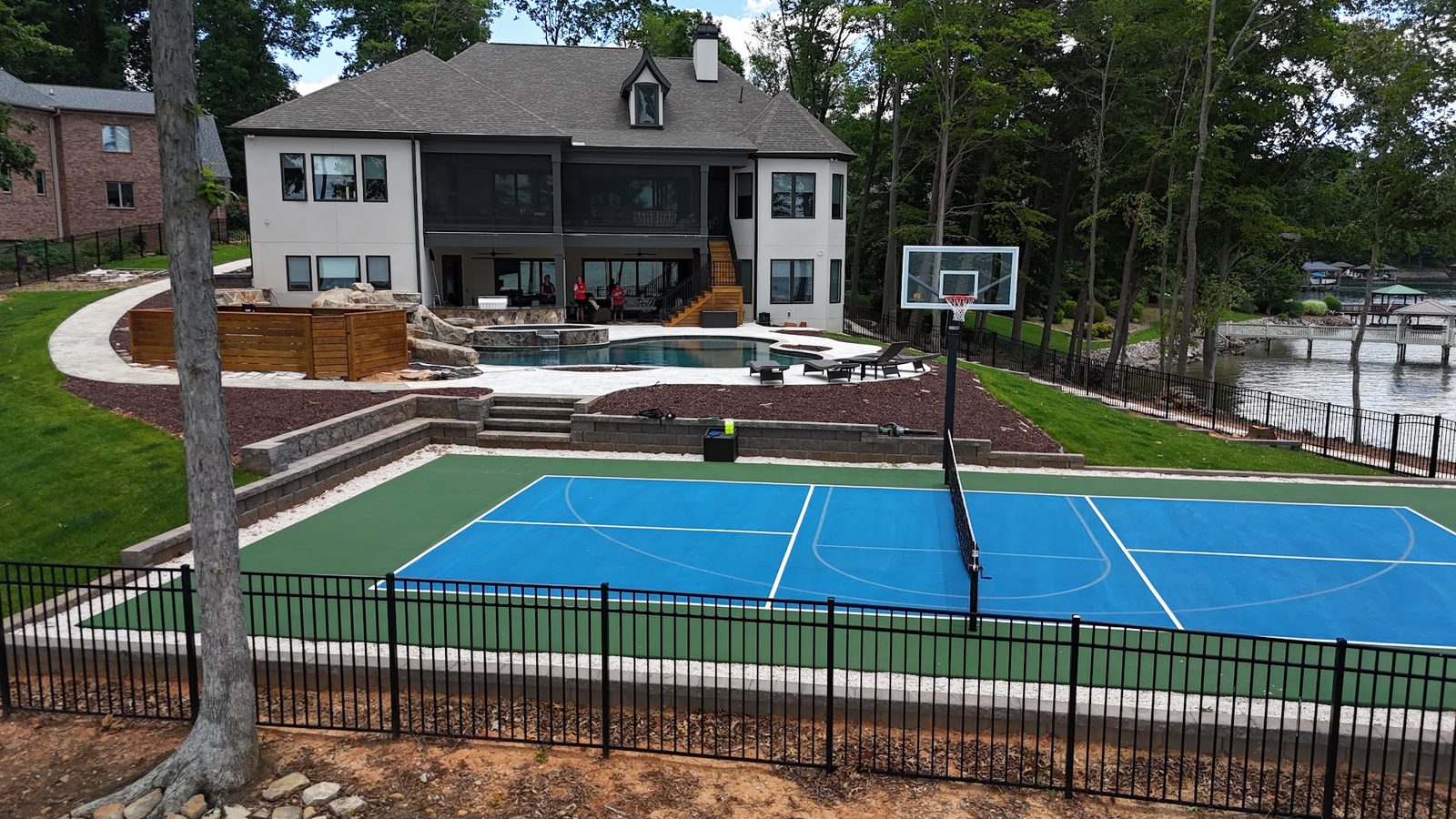
Pool decks. A deck is textured for grip and walked wet and barefoot, and our concrete pool decks page covers the texture. Our cleaning and sealing page says sealing can make a pool deck slippery, which is why grip is chosen alongside the sealer. In our view, ask for the pool water to be covered, or the work scheduled so nothing overhangs it.
Questions about painting after new concrete
Questions to settle when a new slab and a repaint share a year.
How long before painters can set ladders or a lift on a new driveway?
Should I seal the concrete before or after the house is painted?
What if paint or primer lands on unsealed concrete?
Do the painters have to cover the ground around the house?
Which season suits both jobs?
Sources
Pages marked retrieved were read on 27 October 2026. Figures from our own cure-time guide come from Concrete Network, as cited there.
- Cemstone, Curing and Sealing Concrete, retrieved 2026-10-27.
- SpecChem, SpecSilane 40 technical data sheet, retrieved 2026-10-27.
- Euclid Chemical, Concrete Cure and Seal Selection and Application Guide, retrieved 2026-10-27.
- National Ready Mixed Concrete Association, Concrete in Practice CIP 2, Scaling Concrete Surfaces, retrieved 2026-10-27.
- U.S. EPA, Frequent Questions About Work Practice Standards Under the RRP Rule and Renovation, Repair and Painting Program: Work Practices, retrieved 2026-10-27.
- Diamond Vogel, Technical bulletin: Application Conditions for Exterior Latex Paint, retrieved 2026-10-27.